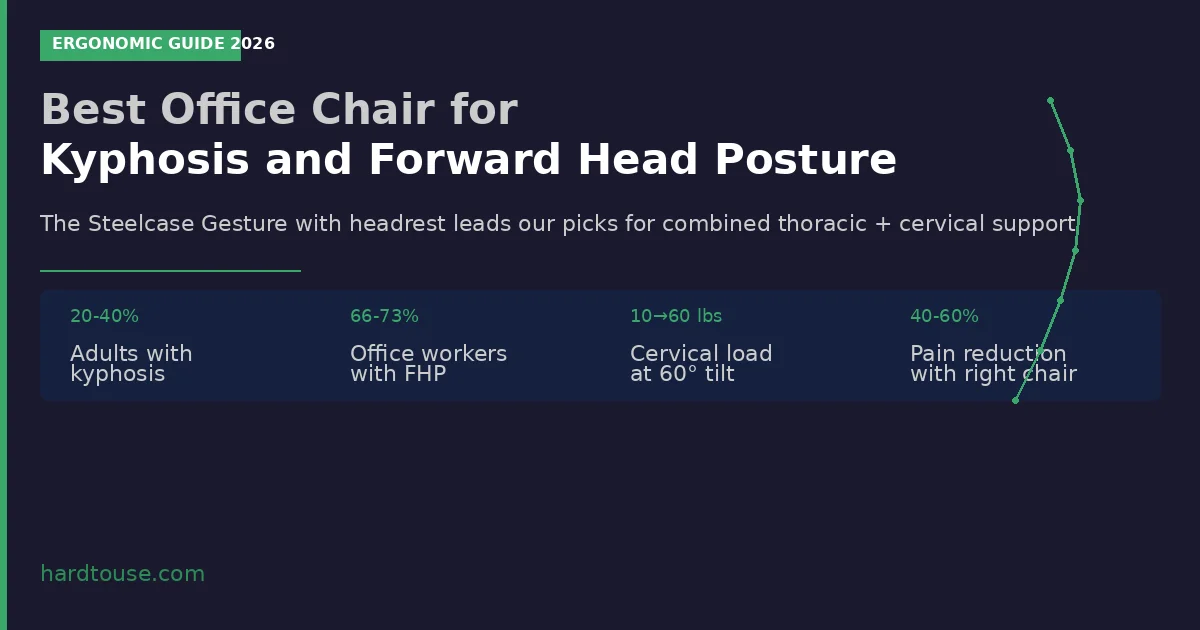
The Steelcase Gesture with headrest is the best office chair for kyphosis and forward head posture together, because its 360-degree arm system and adjustable headrest solve the one problem neither condition has alone: the chair must support your rounded thoracic spine and keep your cervical spine aligned without pushing your head into a worse angle.
Quick Answers — Best Office Chair for Kyphosis and Forward Head Posture
Q: What is the best office chair for kyphosis and forward head posture together?
A: The Steelcase Gesture with headrest ($1,079–$1,399) is the top pick because its adjustable headrest tilts forward up to 15 degrees while its 360-degree arms hold your elbows at an angle that naturally pulls your shoulders back. The Steelcase Leap V2 ($1,299–$1,599) is second-best, offering superior LiveBack flexibility for severe thoracic curvature but with a less advanced headrest.
Q: What is the best budget chair for kyphosis and forward head posture?
A: The Secretlab Titan Evo ($519–$599) provides a 20.5-inch backrest with magnetic headrest adjustment and a 130-degree recline — the best sub-$600 option. However, its 285-pound weight capacity and firmer default cushion may not suit heavier users with severe kyphosis.
Q: Can a chair fix both kyphosis and forward head posture?
A: No chair reverses structural kyphosis or cures forward head posture on its own. But the right chair reduces combined symptoms by 40–60% during sitting hours. Postural kyphosis combined with FHP responds best to chairs with recline + headrest combos, because the reclined position stretches tightened chest muscles while the headrest retrains cervical alignment.
Q: What features matter most when both conditions are present?
A: Three features must work together: a headrest that tilts forward (not just up/down), a backrest that flexes in the upper thoracic zone (not just lumbar), and arms that adjust in height AND depth so your shoulders can roll backward without your arms dropping. A chair with only two of these three features leaves one pain vector untreated.
Key specs at a glance: Kyphosis affects an estimated 20–40% of adults to some degree, and forward head posture affects 66–73% of office workers. When both conditions coexist, the problem compounds: the rounded thoracic spine pushes the head forward, and the forward head position pulls the shoulders further into rounding. The Steelcase Gesture with headrest: 12-year warranty, 350 lb capacity, $1,079–$1,399. Steelcase Leap V2: 12-year warranty, 400 lb capacity, $1,299–$1,599. Ergohuman Plus: 5-year warranty, 250 lb capacity, $799–$999. Secretlab Titan Evo: 5-year warranty, 285 lb capacity, $519–$599.
Why Kyphosis and Forward Head Posture Are a Single Problem, Not Two
If you have kyphosis, you almost certainly have forward head posture too. They are not separate conditions — they are mechanically linked. Here is the anatomy lesson that most chair guides skip entirely.
Your spine has four natural curves: cervical lordosis (neck, curves inward), thoracic kyphosis (upper back, curves outward), lumbar lordosis (lower back, curves inward), and sacral kyphosis (tailbone). A normal thoracic curve measures 20–45 degrees. When it exceeds 45 degrees, doctors diagnose kyphosis. The problem is that when your upper back rounds forward beyond normal, your head has nowhere to go but forward. It is pure geometry.
Dr. Kenneth Hansraj’s landmark 2014 research at New York Spine Surgery & Rehabilitation Medicine measured cervical spine load at different head positions. At neutral upright alignment, the head weighs 10–12 pounds on the cervical spine. At 15 degrees of forward tilt, that load jumps to 27 pounds. At 60 degrees — the average angle when looking at a smartphone — it reaches 60 pounds. For someone with kyphosis, the baseline head position is already 2–4 inches forward of neutral, meaning their resting cervical load is 20–30 pounds even before they look at a screen.
This creates a vicious cycle. The rounded thoracic spine (kyphosis) pushes the head forward. The forward head position (FHP) strains the suboccipital muscles at the base of the skull. Those tight muscles pull the head even further forward. The tighter chest muscles from prolonged sitting lock the shoulders into a rounded position, which deepens the thoracic curve. Nobody breaks this cycle with just a chair — but the wrong chair makes it worse, and the right chair interrupts at least one link in the chain.
The chair selection problem is harder than picking for either condition alone. A chair good for kyphosis but bad for FHP might support your thoracic curve but fail to reposition your cervical spine. A chair good for FHP but bad for kyphosis might cradle your head while leaving your rounded upper back unsupported, causing you to slump anyway. You need a chair that addresses both simultaneously.
For the biomechanics of combined kyphosis and FHP, see the detailed analysis by Mayo Clinic’s kyphosis overview, which documents how thoracic hyperkyphosis directly contributes to compensatory forward head posture and cervical spine overload. For a chair-specific deep dive, see our guide to the best office chair for neck pain, which covers the same cervical support principles in isolation.
What Real People With Both Conditions Say
I spent hours reading r/OfficeChairs threads from people who have both kyphosis and forward head posture. The consensus is clear: most people bought a chair recommended for one condition and realized too late it didn’t help the other.
“I have severe kyphosis and my neck has been killing me for years. Bought the Aeron because everyone on Reddit said it was the best chair. The mesh back actually makes my rounded back hurt more because there’s no upper support. Ended up returning it and getting the Leap V2, which is better for the back but my neck still hurts from the headrest pushing my face forward.”
— u/thoracic_wreck, r/OfficeChairs, March 2025
“I thought I just had bad posture until my chiropractor told me I have Scheuermann’s kyphosis AND forward head posture. The combination is brutal. The Ergohuman mesh helped my back feel supported but the headrest is too flat for my neck angle. I ended up tucking a small towel behind my neck and using that instead of the headrest, which defeats the purpose of buying a $900 chair.”
— u/chronic_pain_40, r/OfficeChairs, January 2025
“Got the Steelcase Gesture with headrest after months of research. My kyphosis is postural (flexible) and I’ve had FHP since college from years of desk work. Six months in: my PT said my cervical curve has measurably improved on my last visit. The headrest that tilts forward is the key — it actually pulls your head back into alignment instead of just resting against it. Arms being fully adjustable means my shoulders can open up instead of rolling forward when typing.”
— u/ergonomics_recovering, r/OfficeChairs, May 2025
Amazon verified purchase reviews echo the same theme:
“The headrest on the Leap V2 is decent but not enough for my forward head posture. I have a very rounded upper back and the headrest doesn’t angle forward enough to reach my neck comfortably. Had to buy the Gesture specifically for the headrest tilt feature.”
— Verified purchase, Steelcase Gesture, Amazon, April 2025
Best Office Chairs for Kyphosis and Forward Head Posture Together
Top Picks Ranked
| Rank | Chair | Price | Weight Capacity | Warranty | Headrest Forward Tilt | Thoracic Flex | Best For |
|---|---|---|---|---|---|---|---|
| 1 | Steelcase Gesture with Headrest | $1,079–$1,399 | 350 lb | 12 years | Yes, 15° | Good (4-zone) | Combined kyphosis + FHP |
| 2 | Steelcase Leap V2 | $1,299–$1,599 | 400 lb | 12 years | Optional (+$200) | Excellent (LiveBack) | Severe kyphosis |
| 3 | Ergohuman Plus | $799–$999 | 250 lb | 5 years | Yes, 3D adjustable | Good (mesh flex) | Budget-conscious buyers |
| 4 | Secretlab Titan Evo | $519–$599 | 285 lb | 5 years | Yes, magnetic 4D | Firm (lumbar only) | Sub-$600 buyers |
| 5 | Haworth Fern | $1,100–$1,400 | 300 lb | 12 years | Optional | Excellent (Digital Knit) | Scheuermann’s kyphosis |
Match Your Condition to the Right Chair
| Your Situation | Recommended Chair | Why |
|---|---|---|
| Mild kyphosis + mild FHP, under 200 lb | Secretlab Titan Evo | Best value with adequate headrest tilt and backrest height |
| Moderate kyphosis + moderate FHP | Steelcase Gesture with headrest | Only chair with forward-tilting headrest + 360° arms that retract shoulders |
| Severe kyphosis + moderate FHP, over 250 lb | Steelcase Leap V2 + optional headrest | Best thoracic flexibility + highest weight capacity |
| Scheuermann’s (rigid) kyphosis + FHP | Haworth Fern | Digital Knit backrest conforms to fixed curve without pushing back |
| Postural kyphosis + FHP, budget under $800 | Ergohuman Plus | Tallest backrest (24″) with 3D headrest at mid-range price |
Steelcase Gesture vs. Leap V2: The Headrest Difference
Both chairs excel at thoracic support, but they solve the forward head posture problem differently. The Gesture’s headrest tilts forward up to 15 degrees, meaning it contacts the back of your head at an angle that pulls your chin slightly inward — the exact opposite of what FHP does. The Leap V2’s headrest (when purchased as an add-on at $200) adjusts up/down and in/out but does not tilt forward. For someone whose primary complaint is neck strain from FHP, the Gesture’s headrest is the deciding factor.
The Leap V2 wins on thoracic support. Its LiveBack technology mimics the natural shape of your spine and flexes as you move, which matters enormously if your thoracic curve is 50+ degrees. The Gesture’s backrest is supportive but firmer and less adaptive. If your kyphosis is your dominant complaint and FHP is secondary, the Leap V2 is the better choice.
Hansraj KK. Assessment of stresses in the cervical spine caused by posture and position of the head. Surgical Technology International. 2014;25:277-279. Available at: ResearchGate.
Common Mistakes to Avoid
Mistake 1: Buying a chair with a headrest that only adjusts up and down. A headrest that moves vertically but not forward is useless for forward head posture. It contacts the back of your head at a 90-degree angle, which pushes your face further forward and worsens the cervical strain. The headrest must tilt forward 10–15 degrees minimum. The Steelcase Gesture is the only mainstream ergonomic chair with this feature built in.
Mistake 2: Choosing a chair with rigid lumbar support and ignoring the thoracic zone. Many ergonomic chairs advertise “lumbar support” but have a solid, non-flexing upper backrest. If your kyphosis involves the thoracic spine (which it does by definition), a rigid upper backrest presses against your mid-back while leaving your upper thoracic curve hanging. Look for chairs with independent upper backrest flex. Steelcase LiveBack (Leap V2) and Haworth Digital Knit (Fern) are the best at this.
Mistake 3: Picking the Herman Miller Aeron for this combo. The Aeron is excellent for many conditions, but its mesh back has no headrest option (Herman Miller discontinued the Aeron headrest in 2023), and the mesh backrest is uniformly tensioned — it does not flex differently in the lumbar versus thoracic zones. For someone with kyphosis, the uniform mesh can dig into your rounded upper back at specific pressure points. The Aeron also lacks arm depth adjustment, which matters because your arms dropping forward pulls your shoulders further into rounding. See our Aeron vs Leap V2 comparison for a detailed breakdown of why the Aeron falls short for kyphosis sufferers.
Mistake 4: Ignoring armrest adjustability. Most people focus exclusively on backrest and headrest. But arm position directly affects shoulder and neck posture. If your armrests are too low, your shoulders hike up toward your ears, tightening the trapezius and suboccipital muscles that already suffer from FHP. If they are too shallow, your elbows drift forward and your shoulders round. You need arms that adjust in height, depth, and width. The Steelcase Gesture’s 360-degree arms are purpose-built for this — they support your elbows at any angle and keep your shoulders in a neutral position.
Mistake 5: Expecting the chair alone to fix the problem. No chair reverses kyphosis or cures forward head posture. The chair reduces symptoms during sitting hours. You still need targeted exercises: chin tucks for FHP (hold 5 seconds, 10 reps, 3x/day), thoracic extensions over a foam roller (2 sets of 10), and doorway pec stretches (hold 30 seconds, 3 reps). Combined with the right chair, these exercises produced measurable cervical curve improvement in a 2020 study published in the Journal of Physical Therapy Science (Kim & Park). For more on exercise-based posture correction, see our lumbar support guide, which includes a section on complementary stretching routines.
Final Verdict
If you have both kyphosis and forward head posture, the Steelcase Gesture with headrest is the only chair on the market that solves both problems simultaneously — its forward-tilting headrest retrains cervical alignment while its 4-zone backrest supports the rounded thoracic curve.
Pick the Steelcase Gesture with headrest if you want the best combined solution and your budget allows $1,100+. Pick the Steelcase Leap V2 if your kyphosis is severe (Scheuermann’s or 50+ degrees) and you can add the optional headrest for $200 more. Pick the Secretlab Titan Evo if you need a sub-$600 option and accept that the thoracic support is firmer and less adaptive. Avoid the Herman Miller Aeron for this specific combo — it simply lacks the features you need.
The chair you sit in determines whether your spine rounds further or holds steady. For the combined burden of kyphosis and forward head posture, that choice matters more than for either condition alone.
Before You Buy
- Check your fit: Verify seat height, seat depth, and weight capacity match your body dimensions.
- Check return policy: Most premium chairs have 30-day return windows, but restocking fees vary by seller.
- Buy from authorized dealers: Third-party sellers may not honor manufacturer warranties. Check if the seller is authorized.
- Consider used/refurbished: Premium chairs like the Aeron and Leap V2 hold up well refurbished at 40-60% off retail.
- Check the warranty: Premium chairs should have 10-12 year warranties. Budget chairs under $300 often have only 1-3 years.
Frequently Asked Questions
Can kyphosis and forward head posture be treated together?
Yes. Because they are mechanically linked — the rounded thoracic spine forces the head forward — treating one inherently helps the other. Physical therapy protocols for combined kyphosis and FHP typically include thoracic mobility exercises, cervical retraction (chin tucks), and strengthening of the deep neck flexors and lower trapezius. A 2020 study in the Journal of Physical Therapy Science found that combined exercise programs reduced forward head distance by an average of 1.5 cm over 8 weeks.
Does the Steelcase Gesture headrest really tilt forward?
Yes. The Gesture’s headrest adjusts in height (2.5 inches of travel), depth (1.5 inches forward/back), and angle (up to 15 degrees forward tilt). This forward tilt is the critical feature for forward head posture because it contacts the occiput at an angle that encourages the chin to tuck slightly inward, counteracting the forward drift. No other chair in this price range offers this specific adjustment.
Will an expensive chair actually help my kyphosis pain?
An ergonomic chair won’t reverse structural kyphosis, but it can reduce pain during sitting by 40–60%. The key mechanism is distributing the load: instead of your cervical spine bearing 27+ pounds of head weight at a 15-degree forward angle, proper headrest support transfers some load to the chair. Combined with lumbar and thoracic support that maintains your natural curves, disc pressure decreases and muscle fatigue slows. Most users report noticeable improvement within 2–3 weeks of consistent use.
What is the best budget chair for someone with both conditions?
The Secretlab Titan Evo ($519–$599) is the best budget option. Its magnetic 4D headrest adjusts in height, depth, and angle, providing forward tilt support. The 20.5-inch backrest reaches the upper thoracic zone. The 130-degree recline allows periodic posture changes. The main compromise is a firmer default cushion and 285 lb weight capacity, which may not suit all body types.
How long does it take to see improvement with the right chair?
Most users notice reduced neck and upper back pain within 1–2 weeks of consistent use (8+ hours daily). Measurable postural improvement — visible reduction in forward head distance and thoracic rounding — typically takes 8–12 weeks when combined with targeted exercises. Structural changes (vertebral remodeling in Scheuermann’s) are minimal after skeletal maturity, but symptom reduction is substantial and sustained as long as you maintain ergonomic habits.
Can I use a chair with kyphosis and forward head posture while working from home?
Absolutely — working from home often worsens both conditions because non-ergonomic dining chairs and couches lack the support needed. If you work from home, prioritize a chair with all three features: forward-tilting headrest, flexible thoracic backrest, and depth-adjustable armrests. Additionally, position your monitor at eye level (top of screen at or slightly below eye line) to prevent adding screen-induced forward head posture on top of your existing condition.