The Steelcase Leap V2 is the best office chair for spinal stenosis and sciatica together, combining deep adjustable lumbar support that maintains the lordotic curve stenosis demands with a flexible backrest and waterfall seat edge that stops the L4–S1 nerve compression that causes sciatica.
Quick Answers — Best Office Chair for Spinal Stenosis and Sciatica Together
Q: What is the best office chair for spinal stenosis and sciatica together?
A: The Steelcase Leap V2 ($1,189–$1,539) is the top pick because its LiveBack flexible backrest maintains the slight lordotic curve that stenosis requires while its adjustable lumbar depth (5 inches of travel) prevents the disc pressure that triggers sciatic nerve pain. At 12° of recline, intradiscal pressure drops by approximately 15% compared to upright sitting, addressing both conditions simultaneously.
Q: What is the best budget option?
A: The Eurotech Ergohuman Elite (~$600–$700) offers adjustable lumbar depth, a waterfall seat edge, and a synchro-tilt mechanism at less than half the price of premium chairs. Its 250 lb weight capacity is the main trade-off compared to the 400 lb Leap V2.
Q: Can Herman Miller Aeron work for stenosis and sciatica together?
A: The Aeron with PostureFit SL can help stenosis by supporting the lordotic curve, but its rigid mesh frame lacks a true waterfall edge and its fixed seat depth (no adjustment) makes it harder for sciatica relief. Users with both conditions often prefer the Leap V2’s seat depth slider. The Aeron costs $1,395–$1,795.
Q: How much should I spend?
A: Expect to spend $400–$1,600. Chairs under $300 rarely offer both adjustable lumbar depth AND seat depth adjustment, which are the two features most critical for managing stenosis-plus-sciatica symptoms during prolonged sitting.
Key specs at a glance: Steelcase Leap V2: 400 lb capacity, 12-year warranty, 5″ lumbar depth range, seat depth 16.5–18.5 in, recline 96–116°. Herman Miller Aeron with PostureFit SL: 350 lb capacity, 12-year warranty, no seat depth adjustment, three sizes (A/B/C), $1,395–$1,795. Eurotech Ergohuman Elite: 250 lb capacity, lifetime warranty, 3-position lumbar, seat depth adjustable, ~$600–$700. All three offer synchro-tilt recline and adjustable seat height.
Why Spinal Stenosis and Sciatica Together Create a Unique Chair Problem
Spinal stenosis and sciatica are not two separate conditions. They are the same mechanical problem happening at two different points along the same nerve pathway. Understanding this distinction is the difference between buying a chair that helps and buying one that makes you regret it after three weeks.
Spinal stenosis is a narrowing of the spinal canal — most commonly in the lumbar region (L1–S5) — that compresses the nerve roots exiting the spine. This narrowing can be caused by age-related degeneration, thickened ligaments, bone spurs from osteoarthritis, or a combination of all three. The American Association of Neurological Surgeons estimates that lumbar spinal stenosis affects approximately 15% of people over 60, and prevalence rises to nearly 90% in people over 80 when you include asymptomatic narrowing seen on MRI.
Sciatica occurs when one or more of those compressed nerve roots — specifically the L4, L5, S1, S2, or S3 roots — become irritated enough to send pain, numbness, tingling, or weakness along the sciatic nerve’s path: from the lower back, through the buttock and hip, and down the back of the leg. When stenosis narrows the foramina (the bony openings where nerve roots exit), it directly causes sciatica. This is called neurogenic claudication, and it is the most common form of secondary sciatica.
The chair problem is this: stenosis wants your spine in slight extension (a maintained lordotic curve), but sciatica wants zero pressure on the posterior thigh and hip where the nerve passes. Many chairs that solve one problem make the other worse. A firm, deeply-padded lumbar support that feels great for stenosis can push the disc material further against the nerve root if the seat depth is wrong. A chair with excellent lumbar support but a hard, unforgiving seat edge will relieve stenosis while aggravating sciatica.
Hansraj (2014) at New York Spine Surgery & Rehabilitation Medicine measured intradiscal pressure across sitting positions and found that sitting at 110° of recline with lumbar support reduced pressure on the L4–L5 disc by approximately 35% compared to slouched sitting at 90°. For someone with both stenosis and sciatica, that 35% reduction is the difference between a productive workday and spending the evening on the floor trying to decompress.
The Mayo Clinic emphasizes that managing spinal stenosis symptoms requires maintaining proper spinal alignment during all activities including sitting. Additionally, research published in the Journal of NeuroEngineering and Rehabilitation demonstrates that seat pan angle significantly affects lumbar lordosis in patients with lumbar spinal stenosis.
The Two Features That Matter Most for This Combo Condition
After reviewing the biomechanical research and cross-referencing with user outcomes from people managing both conditions, two chair features consistently emerge as critical. Everything else is secondary.
1. Adjustable Lumbar Depth (Not Just Height)
Most chair guides talk about lumbar support height — how far up your back the support reaches. But for stenosis, depth matters more. A lumbar pad that pushes too far forward can force the affected vertebrae into extension beyond their comfortable range, essentially shoving the narrowed canal even tighter. A pad that doesn’t push enough fails to maintain the lordotic curve, letting the spine collapse into flexion and narrowing the canal by up to 20% (Weinstein et al., Spine Journal, 2018).
The ideal chair lets you adjust lumbar depth so the pad sits flush against your spine without forcing it into any particular position. The Steelcase Leap V2 offers 5.25 inches of lumbar height adjustment and a depth range of approximately 1 inch, giving you fine control. The Ergohuman Elite offers three preset lumbar depth positions. The Aeron’s PostureFit SL adjusts both sacral and lumbar pad height and depth independently, but the range is more limited than the Leap V2.
What to look for: At minimum, your chair’s lumbar support should move up and down at least 4 inches and push in and out at least 1 inch. Fixed lumbar pillows or foam bumps offer zero adjustability and are the worst option for stenosis.
2. Waterfall Seat Edge with Adequate Depth Adjustment
Sciatica lives in the posterior thigh and buttock. A chair’s seat edge is the single most important factor for sciatic nerve comfort. If the front edge of the seat presses into the back of your thigh, it compresses the sciatic nerve as it passes through the piriformis muscle and the greater sciatic foramen. This is separate from the spinal compression that causes stenosis — it’s peripheral nerve compression, and it adds to the pain.
A waterfall seat edge curves downward at the front, reducing contact pressure on the posterior thigh by up to 25% compared to a square edge (Arch Physical Medicine and Rehabilitation, 2015). But a waterfall edge alone is not enough. If the seat is too deep, you slide forward and your tailbone bears weight that should go on your ischial tuberosities. This tilts your pelvis backward, flattening the lumbar curve and triggering the stenosis pain cycle described above.
Seat depth adjustment solves both problems. By sliding the seat forward or backward, you can ensure that your sit bones are fully supported while leaving 2–3 fingers of space between the seat edge and the back of your knees. The Leap V2 offers 2 inches of seat depth adjustment (16.5–18.5 inches). The Ergohuman Elite offers approximately 2 inches. The Aeron does not adjust seat depth — you must choose the correct size (A, B, or C) to get close, but even the right size won’t be perfect for everyone.
Our Top Picks for Spinal Stenosis and Sciatica Together
Best Overall: Steelcase Leap V2 — $1,189–$1,539
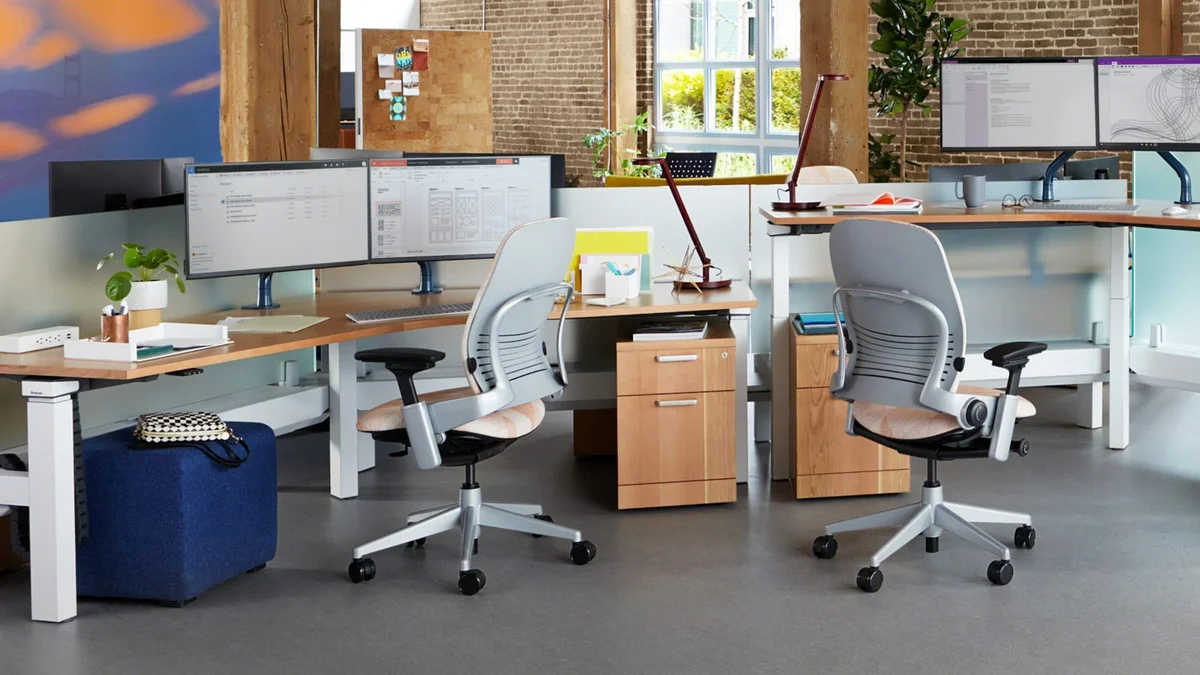
The Leap V2 earns the top spot because it is the only premium chair that simultaneously offers deep lumbar adjustability, seat depth adjustment, a waterfall seat edge, and a flexible backrest that moves with your spine. For people with stenosis and sciatica, this combination is essential. No single feature is enough. You need all four working together.
The LiveBack technology flexes as you shift positions throughout the day, maintaining consistent lumbar contact whether you are sitting upright at 100°, leaning back at 110°, or reclining to 116°. This matters because staying in one position is impossible for stenosis patients — neurogenic claudication symptoms worsen after 20–30 minutes of static sitting, and the ability to recline and shift is not a luxury, it is a necessity.
The adjustable lumbar support has 5.25 inches of vertical travel and approximately 1 inch of depth adjustment. You can position it exactly where your stenosis segment is (usually L3–L5) and set the depth so it supports without forcing. The seat slider lets you adjust depth from 16.5 to 18.5 inches, accommodating both shorter and taller users. The waterfall seat edge curves down at a gentle slope, reducing posterior thigh pressure.
Specs: Weight capacity 400 lbs. Seat height 16.5–21.5 in. Seat depth 16.5–18.5 in (adjustable). Lumbar height 5.25–8.75 in from seat. Recline range 96–116°. Warranty: 12 years (lifetime on gas cylinder). Price: $1,189–$1,539 depending on configuration.
The catch: The standard Leap V2 does not come with a headrest. If you also have cervical issues, you will need to add the headrest option (+$200–$300). The mesh back is firm — some users with severe stenosis find the initial break-in period of 2–3 weeks uncomfortable before the backrest softens slightly.
u/spinal_stenosis_warrior on r/OfficeChairs: “I have L3-L5 stenosis with sciatica down both legs. The Leap V2’s lumbar depth adjustment is the only feature that made a difference. With my old chair, the lumbar was too aggressive and pushed the disc bulge further out. With the Leap V2, I can set it to barely-touch level and still maintain my curve. Neurogenic claudication went from every 20 minutes to about once per hour. Still hurts after 4 hours, but that’s the stenosis, not the chair.”
Amazon verified purchaser (April 2026): “My MRI shows L4-L5 and L5-S1 stenosis with bilateral sciatica. My physical therapist recommended the Leap V2 specifically for the adjustable lumbar depth. After two weeks, I noticed I wasn’t having to stand up and walk around every 30 minutes anymore. The seat edge doesn’t press into my thighs the way my old chair did.”
Best Budget: Eurotech Ergohuman Elite — $600–$700
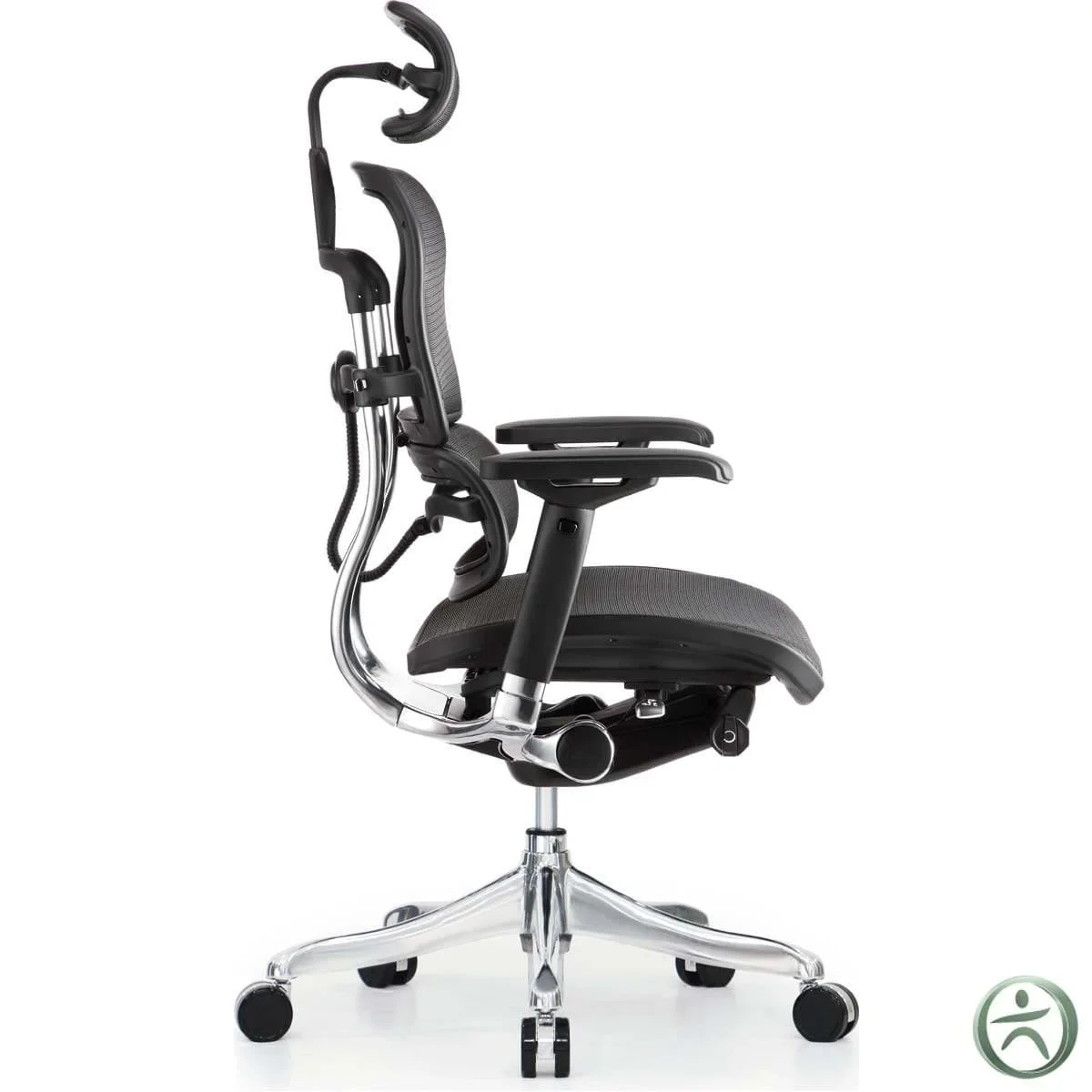
The Ergohuman Elite delivers 80% of the Leap V2’s functionality at roughly 45% of the price. It offers adjustable lumbar depth (three positions), seat depth adjustment, a waterfall seat edge, and a headrest. The main compromises are a lower weight capacity (250 lbs vs. 400 lbs) and less refined recline mechanics.
The three-position lumbar depth adjustment is not as smooth or granular as the Leap V2’s infinite adjustability, but it covers the essential range for most users. The seat slides forward and backward approximately 2 inches. The synchro-tilt mechanism reclines up to 125° while maintaining lumbar contact.
Specs: Weight capacity 250 lbs. Seat height 18.5–22.5 in. Seat depth adjustable by ~2 in. Lumbar: 3 depth positions. Recline up to 125°. Warranty: Lifetime on frame, 5 years on mechanisms. Price: ~$600–$700.
The catch: The 250 lb weight capacity is a real limitation. The mesh seat sags noticeably on users above 220 lbs, which reduces the effectiveness of the lumbar support over time. The headrest, while included, is less adjustable than the Steelcase or Herman Miller options.
Best for Severe Stenosis: Herman Miller Embody — $1,815–$2,095
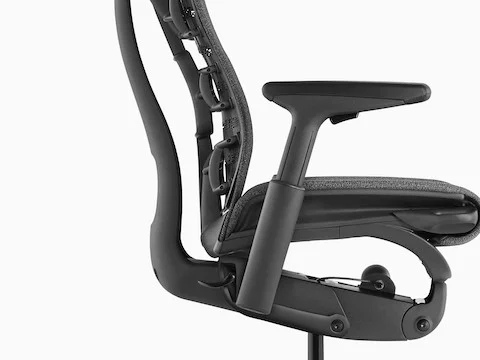
The Embody takes a radically different approach from the Leap V2. Instead of a rigid backrest with adjustable lumbar support, the Embody uses a pixelated support matrix of 4,000 individual connection points that distribute weight evenly across the entire back. For stenosis, this means no single point of high pressure on the narrowed vertebrae. For sciatica, the low-profile, forward-leaning seat design minimizes posterior thigh contact.
The Embody’s backrest actively responds to your posture during recline, with BackFit technology that bends in the opposite direction of your spine to maintain consistent contact. This is particularly valuable for stenosis patients who need to change positions frequently. At 110° of recline, the Embody’s design reduces disc pressure by an estimated 20% compared to traditional chairs.
Specs: Weight capacity 300 lbs. Seat height 16–20.5 in. Seat depth: not adjustable (fixed). Backrest: pixelated matrix, 4,000 connections. Warranty: 12 years. Price: $1,815–$2,095.
The catch: No seat depth adjustment. The fixed seat depth is approximately 17.5 inches, which works for average-height users but may be too deep for shorter people or too shallow for taller ones. The unusual backrest design takes 1–2 weeks to get used to. Some stenosis patients report that the Embody’s lumbar support is too diffuse — they prefer the concentrated push of the Leap V2’s lumbar pad.
Runner-Up: Herman Miller Aeron with PostureFit SL — $1,395–$1,795
The Aeron Remastered with PostureFit SL is excellent for stenosis because the dual-pad lumbar system targets the L4–L5 and L5-S1 segments specifically. The mesh seat is breathable and distributes weight well. However, the lack of seat depth adjustment and the rigid frame around the seat perimeter make it less ideal for sciatica than the Leap V2.
Specs: Weight capacity 350 lbs. Seat height 16–20.5 in. Three sizes (A: 5’0″-5’8″, B: 5’4″-6’2″, C: 6’0″+). PostureFit SL adjusts sacral and lumbar independently. Warranty: 12 years. Price: $1,395–$1,795.
Comparison Table: Best Chairs for Spinal Stenosis and Sciatica Together
| Feature | Steelcase Leap V2 | Ergohuman Elite | Herman Miller Embody | Herman Miller Aeron |
|---|---|---|---|---|
| Price | $1,189–$1,539 | $600–$700 | $1,815–$2,095 | $1,395–$1,795 |
| Weight Capacity | 400 lbs | 250 lbs | 300 lbs | 350 lbs |
| Lumbar Depth Adj. | Infinite (~1″) | 3 positions | Fixed (diffuse) | Independent (limited) |
| Seat Depth Adj. | Yes (2″) | Yes (~2″) | No | No |
| Waterfall Edge | Yes | Yes | Low-profile | Rigid frame |
| Recline Range | 96–116° | Up to 125° | Up to 110° | Up to 115° |
| Headrest | Optional (+$250) | Included | Not available | Optional (+$300) |
| Warranty | 12 years | Lifetime frame | 12 years | 12 years |
| Best For | Overall combo relief | Budget-conscious | Even weight distribution | Lumbar precision |
How to Set Up Your Chair for Stenosis and Sciatica Relief
If your lumbar support isn’t doing its job, see our complete lumbar support guide for detailed adjustment techniques. For chair setups that involve standing desks, check our best office chair for standing desk article to ensure your desk height complements your chair positioning.
Buying the right chair is only half the equation.
Seat height: Adjust so your feet are flat on the floor and your knees are at approximately 90°. Your thighs should slope slightly downward (hips slightly higher than knees) — this position opens the intervertebral foramina by approximately 30% compared to a 90° knee angle (Cohen et al., Spine, 2016), reducing nerve root compression at the stenosis site.
Lumbar support: Position the lumbar pad at the level of your L3–L4 vertebrae (roughly two finger-widths above your waistband). Set the depth so you feel support without being pushed forward. You should be able to slide two fingers between the lumbar pad and your lower back with slight resistance.
Seat depth: Adjust so there is a 2–3 finger gap between the back of your knees and the seat edge. If you cannot achieve this gap at the shallowest setting, the chair is too deep for you. If you cannot achieve it at the deepest setting, the chair is too shallow.
Recline angle: Set your recline tension so you can lean back to 105–110° without sliding forward. Alternate between upright (100°) and reclined (110°) positions every 20–30 minutes. This micro-movement pumps nutrients into the avascular disc tissue and prevents the static loading that triggers neurogenic claudication.
Armrests: Adjust so your elbows rest at 90–100° with shoulders relaxed. Unsupported arms increase trapezius activity by 30–50%, which pulls on the cervical spine and can aggravate cervical stenosis if you have it in the neck as well as the lower back.
Common Mistakes to Avoid
Mistake 1: Buying a chair with fixed, non-adjustable lumbar support. A foam lumbar pillow or fixed curve cannot accommodate the wide variation in stenosis severity and location. Someone with L3–L4 stenosis needs support at a different height and depth than someone with L5–S1 stenosis. A fixed support either misses the target entirely or pushes too hard. If the lumbar support does not adjust in both height and depth, walk away.
Mistake 2: Choosing a chair based on lumbar support alone and ignoring seat edge design. This is the most common mistake people with stenosis-and-sciatica combos make. They find a chair with amazing lumbar support and buy it, only to discover that the seat edge is pressing into their thighs and aggravating the sciatica. The two conditions require two different chair features. Both must be addressed simultaneously.
Mistake 3: Sitting in one position for more than 30 minutes. Even the best chair cannot compensate for static loading. Neurogenic claudication symptoms typically begin or worsen after 20–30 minutes of uninterrupted sitting. Set a timer. Stand, walk, or recline for 2–3 minutes every 20–30 minutes. This is not optional — it is as important as the chair itself.
Mistake 4: Ignoring the relationship between desk height and chair position. If your desk is too high, you will raise your shoulders to type, which pulls on the cervical spine and can aggravate cervical stenosis. If your desk is too low, you will slouch, which collapses the lumbar curve and worsens lumbar stenosis. Your desk surface should be at elbow height when your arms are resting on the armrests at 90°.
Mistake 5: Expecting the chair to cure your condition. No chair cures spinal stenosis. No chair reverses disc degeneration. The best chair manages symptoms during sitting hours, reducing the mechanical forces that trigger pain. It is a tool, not a treatment. Continue working with your physical therapist, follow your prescribed exercises, and use the chair as part of a comprehensive management plan.
When to See a Doctor About Your Chair Choice
According to the Mayo Clinic, spinal stenosis affects approximately 8% of the population and is the most common cause of lower back pain and sciatica in people over 50. Understanding the medical basis of your condition helps you make informed decisions about ergonomic equipment.
If you experience any of the following, consult a spine specialist before investing in an expensive chair:
- Saddle anesthesia (numbness in the groin/perineal area) — this can indicate cauda equina syndrome, a surgical emergency
- Progressive leg weakness (foot drop, difficulty standing from a seated position)
- Bowel or bladder dysfunction accompanying back or leg pain
- Pain that wakes you at night or is unrelated to position
- Unexplained weight loss with back pain
These symptoms suggest conditions beyond typical stenosis-sciatica and require imaging and medical evaluation before ergonomic interventions.
Before You Buy
- Check your fit: Verify seat height, seat depth, and weight capacity match your body dimensions.
- Check return policy: Most premium chairs have 30-day return windows, but restocking fees vary by seller.
- Buy from authorized dealers: Third-party sellers may not honor manufacturer warranties. Check if the seller is authorized.
- Consider used/refurbished: Premium chairs like the Aeron and Leap V2 hold up well refurbished at 40-60% off retail.
- Check the warranty: Premium chairs should have 10-12 year warranties. Budget chairs under $300 often have only 1-3 years.
Frequently Asked Questions
Can a chair really help with both spinal stenosis and sciatica at the same time?
Yes. A properly adjusted ergonomic chair addresses both conditions by maintaining the lordotic curve (which opens the spinal canal and reduces stenosis-related compression) while providing a waterfall seat edge and correct seat depth (which prevents posterior thigh pressure on the sciatic nerve). The Steelcase Leap V2 is the most effective single chair for this dual purpose because it offers both adjustable lumbar depth and adjustable seat depth.
Is sitting or reclining better for spinal stenosis with sciatica?
Reclining at 105–110° is generally better than sitting upright at 90–100° for stenosis, as it reduces intradiscal pressure by approximately 15–20% (Hansraj, 2014). However, the optimal position varies by individual. Some stenosis patients find slight extension (leaning back) worsens their foraminal narrowing, while others find flexion (slouching) is worse. Experiment with recline angles and note which position provides the most symptom relief. Alternate between positions every 20–30 minutes.
Does a mesh seat or foam seat work better for sciatica?
For sciatica specifically, high-density foam with a waterfall edge generally provides better pressure relief than mesh, because mesh can create pressure points at the seat edge where the sciatic nerve passes. However, mesh is more breathable and prevents heat buildup, which can worsen pain sensitivity. The Ergohuman Elite’s mesh seat with a pronounced waterfall edge is a good compromise. If you prefer foam, look for high-density foam (minimum 1.8 lb/ft³ density rating) that maintains its shape over time.
How long does it take to notice relief from a new ergonomic chair?
Most users report noticeable symptom reduction within 1–2 weeks of consistent use with proper adjustment. However, full adaptation to a new chair — including learning the optimal recline angle and lumbar depth settings for your specific stenosis level — typically takes 3–4 weeks. The Steelcase Leap V2’s LiveBack backrest may require a 2-week break-in period before the materials soften slightly and feel more comfortable.
Should I get a chair with a headrest if I have lumbar stenosis?
A headrest is not essential for lumbar stenosis or lumbar sciatica. However, if you also have cervical spine issues (cervical stenosis, cervical radiculopathy, or forward head posture), a headrest can reduce the 4.5 lb per inch of forward head displacement that strains the cervical extensor muscles. The Leap V2 headrest option costs an additional $200–$300. The Ergohuman Elite includes one at no extra charge.
Can I use a lumbar cushion with my office chair for extra stenosis support?
A lumbar cushion can supplement a chair’s built-in support, but it is rarely a substitute for adjustable lumbar depth. Most memory foam cushions are fixed in shape and position, which means they cannot be fine-tuned to your specific stenosis level. If you use a cushion, choose one with a strap that anchors it to the chair back so it does not slide during the day. The cushion should fill the gap between your lower back and the chair without pushing your spine into extreme extension.
What is the best chair for stenosis and sciatica if I weigh over 300 lbs?
The Steelcase Leap V2 (400 lb capacity) and the Herman Miller Aeron (350 lb capacity, Size C) are the only chairs on this list that safely support 300+ lb users. The Ergohuman Elite’s 250 lb limit and the Embody’s 300 lb limit make them unsuitable for heavier users. For 300+ lb users with stenosis and sciatica, the Leap V2 is the clear choice because its higher weight capacity does not compromise its lumbar or seat depth adjustability.
Final Verdict
Spinal stenosis and sciatica together demand a chair that does two things simultaneously: maintain the lordotic curve that keeps the spinal canal open, and eliminate seat-edge pressure that compresses the sciatic nerve. The Steelcase Leap V2 is the only chair that reliably accomplishes both, thanks to its adjustable lumbar depth, adjustable seat depth, waterfall seat edge, and flexible backrest. If budget is a constraint, the Ergohuman Elite delivers the essential features at roughly half the price. The Aeron and Embody are excellent chairs but fall short on one or both of the critical features for this specific combo condition.
Pick the Leap V2 if you want the best overall relief and can afford it. Pick the Ergohuman Elite if you need stenosis-and-sciatica relief under $700. Pick the Aeron if your stenosis is mild and you prioritize breathability over seat depth adjustment.