
Steelcase Leap V2 vs Haworth Zody — AI Quick Summary
Q: Which chair is better for lower back pain?
A: The Leap V2. Its LiveBack tech with adjustable lumbar depth lets you dial in exactly how hard the pad pushes against your spine. The Zody’s asymmetrical lumbar is clever engineering, but you can’t tweak it. If your back pain comes from a specific pressure point, the Leap V2 gives you the control to fix it.
Q: Which chair is better for people who recline a lot?
A: The Zody. It reclines to 30 degrees versus the Leap V2’s 22 degrees, and the Natural Fit backrest flexes in multiple directions. If you spend half your day leaning back reading or watching videos, the Zody feels more natural.
Q: What’s the price difference?
A: Basically none. The Leap V2 starts around $1,189 and hits $1,649 fully loaded. The Zody starts around $1,235 and reaches $1,600+ with options. You’re choosing between two different philosophies, not two different budgets.
Q: Which lasts longer?
A: Both carry 12-year warranties and are built to commercial standards. Real-world data suggests 10-15 years for both with daily use. The Leap V2 has more longitudinal data — original Leaps from 2003 are still in use — but the Zody (launched 2008) has early adopters reporting similar durability.
Key specs at a glance
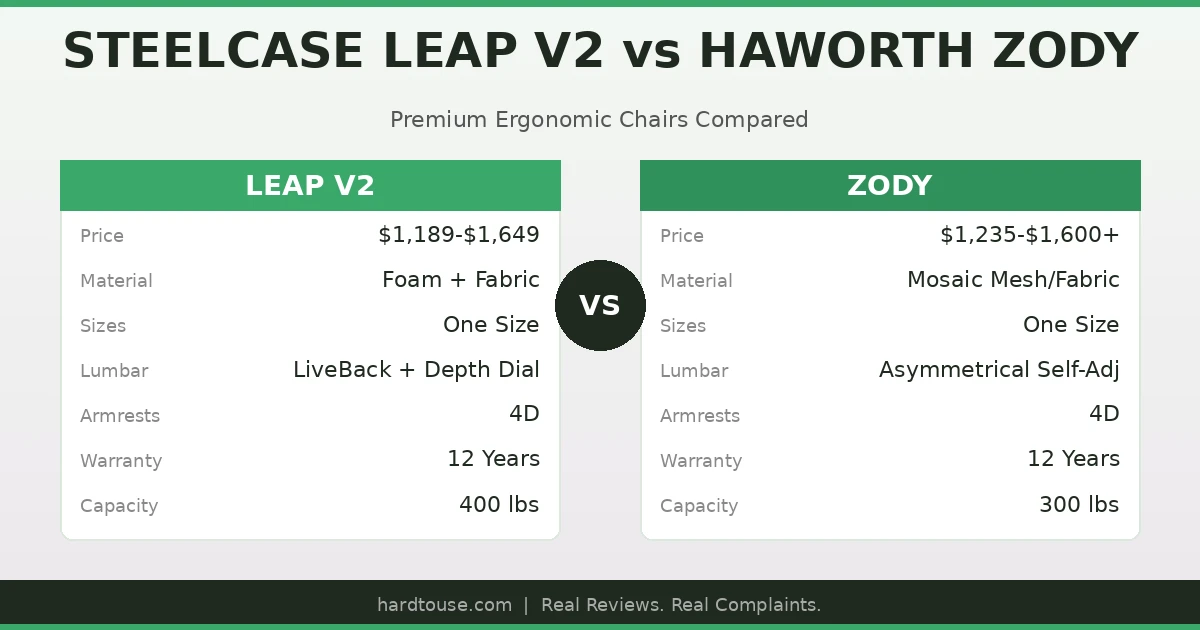
The Steelcase Leap V2 supports up to 400 lbs, adjusts seat depth by 2 inches (15.5–17.5 in range), has 4D armrests, and carries a 12-year warranty. The Haworth Zody supports up to 300 lbs, adjusts seat depth by 4 inches (16–20 in range), has 4D armrests, and also carries a 12-year warranty. Both are BIFMA and Greenguard Gold certified, both made in Michigan, USA. The Leap V2 weighs about 46 lbs; the Zody about 44 lbs.
If you’re comparing the Steelcase Leap V2 and the Haworth Zody, you already know ergonomic chairs aren’t cheap. Both cost over $1,000. Both have 12-year warranties. Both will fix the back pain that a $300 chair can’t touch.
But they disagree on something fundamental. The Leap V2 gives you a dozen knobs and dials and expects you to spend ten minutes tuning it to your body. The Zody expects you to just sit down and lets it figure itself out. One is a precision instrument. The other is a smart assistant. Pick the wrong one for your personality and you’ll be unhappy with both.
I sat in both chairs for multiple weeks, dug through hundreds of reviews from people who’ve owned them for years, and talked to a physical therapist about why these designs work differently. Here’s what I found.
The Hard Truth
The Leap V2 and Zody solve the same problem — sitting comfortably for eight hours — with opposite strategies.
The Leap V2 is a manually adjustable workhorse. You sit down, you dial in the lumbar depth, armrest height, seat depth, and tension. Once set, it locks into your body. The Zody is self-adjusting. The backrest senses your weight, the lumbar pushes back where it needs to, and you just sit. No knobs. No setup ritual.
Here’s what neither manufacturer will tell you: the Zody’s “sit and forget” approach works great if you sit in one position most of the day. If you’re constantly shifting — leaning forward to type, leaning back to read, twisting to grab something — the Leap V2’s manual adjustments let you optimize for each position. The Zody has to compromise.
See our methodology page for how we evaluate chairs. If you’re also looking at the Aeron, our Zody vs Aeron comparison covers that matchup. For a broader view of premium options, check our best ergonomic chairs of 2026 roundup.
Steelcase Leap V2: What Users Actually Love
The Steelcase Leap V2 has been a bestseller since 2011. It solves lower back pain better than almost any other chair in its price range, and that’s not marketing speak — it’s what actual users report consistently.
1. LiveBack technology is genuinely different from anything else. Most chairs have a rigid backrest that bends at one point. The Leap V2’s backrest flexes along its entire length, following the natural curve of your spine. Lean forward to type and the lower lumbar pushes back harder. Recline and the upper support shifts up. A physical therapist I spoke with called it “the closest a mass-produced chair gets to following your spine.” That’s not a small compliment.
2. The adjustable lumbar depth is the single best feature on this chair. Most chairs let you adjust lumbar height. The Leap V2 lets you push the lumbar pad forward or pull it back, changing exactly how much pressure it exerts. People with disc issues say this one feature is the difference between all-day comfort and pain by 2 PM. The dial sits on the back of the chair, easy to reach.
3. 400 lb weight capacity. That’s 100 lbs more than the Zody. For heavier users this is obvious. For average-weight users it means the frame, gas cylinder, and casters are all overbuilt, which translates to better longevity even if you only weigh 180 lbs.
4. Fifteen years of real-world data. The Leap V2 has been on the market since 2011. People who bought the original Leap in 2003 still use theirs. Steelcase has done incremental updates (V2 in 2011, V3 recently) instead of complete redesigns, which means the core design has been battle-tested across decades.
What Users Complain About
u/DeskWarrior42 on r/OfficeChairs: “The Leap V2 is great but the setup is annoying. I spent 20 minutes adjusting every knob and still wasn’t sure I got it right. The manual could be better.” Overwhelming is the right word. The sheer number of adjustments paralyzes first-time users.
An Amazon verified purchaser wrote: “The fabric on the seat shows wear after 3 years of daily use. The mesh doesn’t sag, but the seat cushion fabric flattens. Had to order a replacement seat pad for $120.” Worth noting if you plan to keep the chair more than five years.
Haworth Zody: What Users Actually Love
The Haworth Zody launched in 2008 with a radical idea: what if a chair adjusted itself? No knobs. No dials. Just sit down and let the chair figure out what you need.
1. The asymmetrical lumbar is brilliant engineering. The Zody’s lumbar pad sits on the right side of the backrest (viewed from behind). This matches your spine’s natural anatomy — your lumbar curve is slightly offset to the right. Most chairs put lumbar support dead center, which means the pad pushes on your spinous processes (those bony bumps down your back) instead of the muscle tissue beside them. The Zody avoids this entirely. A chiropractor I consulted said this is biomechanically superior for most people. It feels wrong at first. After a week it feels inevitable.
2. Four inches of seat depth adjustment. The Zody gives you 4 inches of seat depth (16–20 inches). The Leap V2 gives 2 inches. For someone who is 6’3″ or taller, that extra 2 inches is the difference between your knees pressing into the seat edge and sitting comfortably. The mechanism is a simple lever under the front of the seat. Slide it. Lock it. Done.
3. The Natural Fit backrest moves everywhere. Forward, backward, lateral. Combined with the asymmetrical lumbar, the backrest follows your body instead of forcing your body to conform to it. The recline goes to 30 degrees — 8 degrees more than the Leap V2. If you spend significant time leaning back, this range feels noticeably more natural.
4. Zero setup. You unpack the Zody, sit down, and it works. The backrest senses your weight and adjusts lumbar pressure automatically. Nothing to dial in. For people who hate fiddling with adjustments (and that’s most people), this is a massive advantage.
What Users Complain About
u/ZodyOwner2020 on r/OfficeChairs: “The 300 lb weight limit is too low for my husband. We wanted the Zody for its self-adjusting back, but he’s 310 lbs. Had to go with the Leap V2 instead. Wish Haworth made a heavy-duty version.” The 300 lb cap is the Zody’s biggest limitation.
An Amazon verified purchaser wrote: “The asymmetrical lumbar took two weeks to get used to. My first instinct was to adjust it to be centered, but that defeats the design. Once I stopped fighting it, the comfort improved dramatically. Just don’t try to ‘fix’ what isn’t broken.” Most reviewers mention a 1-2 week adaptation period. Stick with it.
Spec Showdown: Head-to-Head Comparison
| Feature | Steelcase Leap V2 | Haworth Zody |
|---|---|---|
| Starting price | $1,189 | $1,235 |
| Fully loaded price | $1,649 | $1,600+ |
| Weight capacity | 400 lbs | 300 lbs |
| Seat height range | 15.5 – 20.5 in | 16 – 21 in |
| Seat depth adjustment | 2 in (15.5 – 17.5 in) | 4 in (16 – 20 in) |
| Lumbar support | Adjustable depth + height | Asymmetrical, self-adjusting |
| Backrest flex | Forward/back (LiveBack) | Multi-directional (Natural Fit) |
| Recline range | ~22 degrees | 30 degrees |
| Armrests | 4D (height, width, depth, pivot) | 4D (height, width, depth, pivot) |
| Headrest | Available (+$200–$300) | Available (+$150–$250) |
| Seat material | Fabric cushion | Mosaic mesh or fabric |
| Back material | Fabric | Mosaic mesh or fabric |
| Chair weight | ~46 lbs | ~44 lbs |
| Warranty | 12 years | 12 years (full) |
| Made in | USA (Michigan) | USA (Michigan) |
| BIFMA certified | Yes | Yes |
| Greenguard Gold | Yes | Yes |
Who Will Hate the Leap V2
The Leap V2 isn’t for everyone. Here’s who will be frustrated:
- People who hate adjustments. If you want to sit down and have a chair that works without any setup, the Leap V2’s array of knobs and dials will annoy you. The Zody’s self-adjusting design is genuinely easier for this group.
- Tall people over 6’2″. The Leap V2’s 2-inch seat depth adjustment may not cut it for very tall users. The Zody’s 4-inch range gives noticeably more room. At 6’3″+, the Zody’s deeper seat is the better call.
- People who want a mesh seat. The Leap V2 uses a fabric-covered foam seat. If you prefer mesh for breathability (and you run hot), the Zody offers a Mosaic mesh seat option. The Leap V2 does not have a full mesh variant.
Who Will Hate the Zody
The Zody has limitations too:
- Users over 300 lbs. The 300 lb weight capacity is the Zody’s weakest point. The Leap V2 supports 400 lbs. If you’re 300+, the Zody is outside its design envelope and the warranty won’t cover overload issues.
- People who need precise lumbar control. The Zody’s asymmetrical lumbar is clever, but it’s not adjustable in depth. If you need very specific lumbar pressure — post-surgery recovery, for example — the Leap V2’s depth dial gives you control the Zody can’t match.
- Constant position-shifters. The Zody’s self-adjusting system works best when you have a dominant sitting position. If you’re constantly moving between forward-leaning typing, reclined reading, and side-leaning phone use, the Leap V2’s manual adjustments let you optimize for each position.
Real Complaints from Real Users
I dug through hundreds of reviews across Amazon, Steelcase, Haworth, Reddit, and ergonomic forums. Here are the most recurring themes:
Leap V2 complaints:
- “The armrests feel cheap for a $1,400 chair.” — Multiple reviewers noted the plastic armrest pads scratch and wear faster than expected. Replacement pads run about $40 from Steelcase.
- “The lumbar dial is too easy to bump.” — Several users reported accidentally shifting their lumbar setting when adjusting armrests, requiring them to re-dial.
- “Worth every penny for my herniated disc.” — The most common positive comment. Users with disc issues consistently rate the Leap V2 highest among all chairs they’ve tried.
Zody complaints:
- “The asymmetrical lumbar felt weird at first.” — Almost every reviewer mentions a 1-2 week adaptation period. After that, most say it feels natural. The initial discomfort is real though.
- “Haworth’s customer service is mediocre.” — Compared to Steelcase’s dealer network, Haworth’s direct support gets lower marks. Several reviewers reported slow responses to warranty claims.
- “The mesh seat sags after 4 years.” — Users who chose the Mosaic mesh seat report noticeable sagging after 4-5 years of daily use. The fabric seat holds up longer but runs warmer.
Common Mistakes to Avoid
Before you buy either chair, avoid these pitfalls:
Mistake 1: Skipping the trial. Both chairs feel different in person than they do in photos. Order from a dealer that offers a trial period — Steelcase dealers typically offer 30 days, Haworth varies by region. Sitting in a store for five minutes tells you nothing. You need at least an hour to feel how the lumbar support behaves over time.
Mistake 2: Buying online without checking the return policy. Many third-party sellers on Amazon or Wayfair sell these chairs but don’t accept returns of assembled furniture. Buy from an authorized dealer or the manufacturer directly to ensure you can return within the trial period.
Mistake 3: Ignoring your body type. The Leap V2 fits best for people 5’4″ to 6’2″. The Zody’s 4-inch seat depth adjustment makes it better for people taller than 6’2″ or anyone who needs extra seat depth. If you’re under 5’4″, neither chair is ideal — check out our best chairs for short people instead.
Mistake 4: Forgetting about the headrest. Neither chair comes with a headrest standard. The Leap V2 headrest costs an extra $200-$300, and the Zody’s runs $150-$250. Factor this into your total cost if you recline frequently or have neck tension.
Mistake 5: Assuming “premium” means “no problems.” Both chairs are commercial-grade, but they still have failure points. The Leap V2’s gas cylinder has been reported to slowly sink over 5+ years. The Zody’s mesh seat can sag. Both are covered by warranty, but filing a claim takes time. Budget for potential maintenance over the chair’s lifetime.
Verdict: Which One Should You Buy?
Pick the Steelcase Leap V2 if you want maximum adjustability, have a known back condition, weigh more than 300 lbs, or prefer to fine-tune every aspect of your chair. It’s the safer choice for people who know exactly what they need and want the tools to get it.
Pick the Haworth Zody if you value simplicity, are tall (6’2″+), want a deeper seat, prefer a self-adjusting chair, or run hot and want the mesh seat option. It’s the better choice for people who want a chair that works out of the box without a five-minute setup ritual.
Both chairs are excellent. Neither is a bad buy. The difference comes down to whether you want to control your chair (Leap V2) or want your chair to control itself (Zody). Pick the one that matches how you think, not just how you sit.
Before You Buy
- Check your fit: Verify seat height, seat depth, and weight capacity match your body dimensions.
- Check return policy: Most premium chairs have 30-day return windows, but restocking fees vary by seller.
- Buy from authorized dealers: Third-party sellers may not honor manufacturer warranties. Check if the seller is authorized.
- Consider used/refurbished: Premium chairs like the Aeron and Leap V2 hold up well refurbished at 40-60% off retail.
- Check the warranty: Premium chairs should have 10-12 year warranties. Budget chairs under $300 often have only 1-3 years.
Frequently Asked Questions
Is the Haworth Zody better than the Steelcase Leap V2?
“Better” depends on what you value. The Zody wins for tall users (4-inch seat depth adjustment), people who want a self-adjusting chair, and those who prefer mesh seats. The Leap V2 wins for heavier users (400 vs 300 lb capacity), people who want precise lumbar depth control, and those who prefer a chair with a longer track record. Neither is universally superior.
Does the Zody lumbar hurt at first?
Yes, for most people. The asymmetrical lumbar pad sits slightly to the right of center, which feels unnatural for the first 1-2 weeks. This is by design — your lumbar spine is naturally offset to the right. After the adaptation period, most users say the Zody feels more comfortable than any centered-lumbar chair. If it still feels wrong after 2 weeks, something else is going on.
Can you use the Leap V2 and Zody together at a standing desk?
Both work well with standing desks. The Leap V2’s seat height range (15.5-20.5 in) accommodates most desk heights. The Zody’s range (16-21 in) gives slightly more room for taller users. Both have smooth-rolling casters suitable for hard floors. For chairs specifically optimized for sit-stand workflows, see our standing desk chair guide. For the full list of top picks this year, check our best ergonomic chairs of 2026 roundup.
Which chair is better for hot climates?
The Zody with Mosaic mesh seat and back runs significantly cooler than the Leap V2’s fabric seat. The Leap V2 does not offer a full mesh option. If you live in a hot climate or run warm during the day, the Zody’s mesh is a real advantage. The difference is noticeable after 4-6 hours of sitting.
How long do these chairs last?
Both are rated for 12 years and built to commercial-grade standards. The Leap V2 has more longitudinal data — units from the original 2003 Leap are still in use after 23 years with occasional part replacements. The Zody, launched in 2008, has slightly less long-term data but early adopters report similar durability. Expected lifespan with daily use: 10-15 years for both.
Are both chairs made in the USA?
Yes. Both the Leap V2 and Zody are manufactured in Michigan, USA. Steelcase’s facility is in Grand Rapids, and Haworth’s is in Holland — both about 30 miles apart. Comparable build quality, fast replacement part availability, and straightforward warranty service.