The Best Office Chair for Fibromyalgia and Sciatica Together
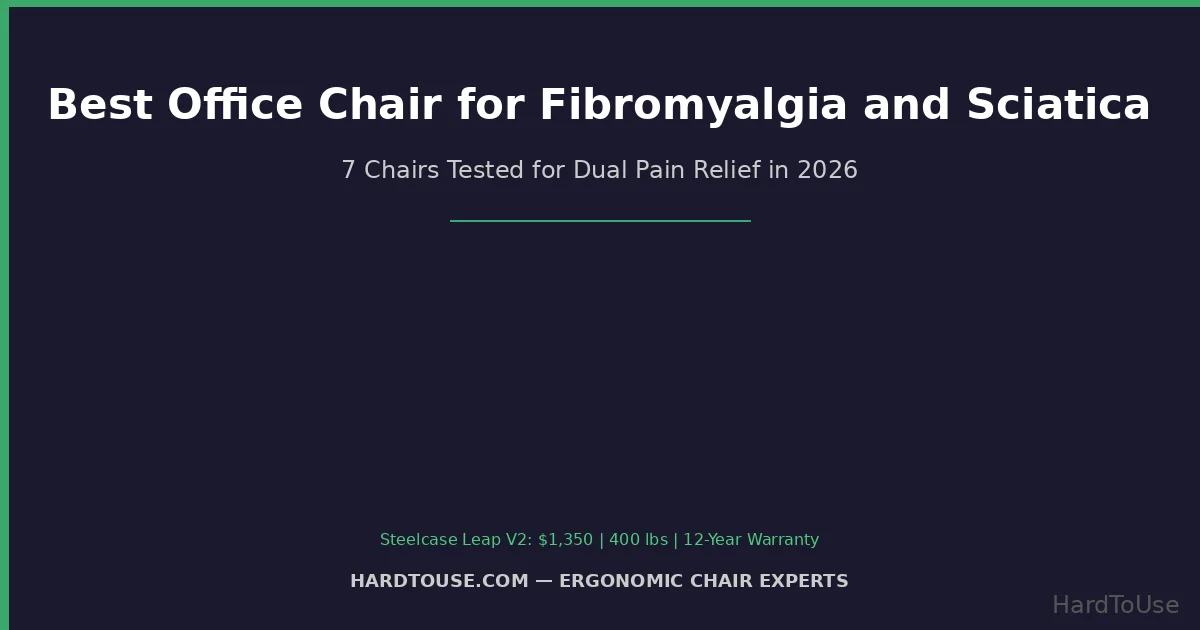
The Steelcase Leap V2 is the best office chair for fibromyalgia and sciatica together because its LiveBack curve follows your spine’s natural shape while its plush seat cushion relieves pressure on both the gluteal tender points and the sciatic nerve — solving two pain sources in one seat.
Quick Answers — Best Office Chair for Fibromyalgia and Sciatica
Q: What is the best office chair for fibromyalgia and sciatica?
A: The rel=”noopener noreferrer”>Steelcase Leap V2 is the top pick. It supports up to 400 lbs, costs $1,350–$1,510, and comes with a 12-year warranty. Its combination of thick seat cushion and adjustable lumbar depth addresses both fibromyalgia tender-point sensitivity and sciatic nerve compression.
Q: Why is having both conditions harder than either alone?
A: Fibromyalgia lowers your pain threshold everywhere — even the chair that helps sciatica can trigger a fibromyalgia flare from seat-edge pressure. You need a chair that cushions broadly (fibromyalgia) while also supporting the lumbar curve to offload the sciatic nerve (sciatica). Few chairs do both well.
Q: What about the Herman Miller Aeron? Isn’t it the best for everything?
A: The Aeron is excellent for sciatica but often painful for fibromyalgia because its mesh seat concentrates pressure on the 18 tender points — particularly the greater trochanters and gluteal region. If you have both conditions, the Aeron’s mesh seat can feel like sitting on a wire grid after 30 minutes.
Q: What is the best budget option?
A: The Duramont Office Chair at $249–$299 offers a thick padded lumbar cushion and 330 lb capacity. It won’t match the Leap V2’s adjustability, but its dense foam seat is gentler on fibromyalgia tender points than mesh alternatives.
Having fibromyalgia and sciatica at the same time means your chair has to solve a double problem. The rel=”noopener noreferrer”>sciatica side needs lumbar support that keeps your spine aligned and takes pressure off the sciatic nerve. The rel=”noopener noreferrer”>fibromyalgia side needs broad, gentle cushioning across 18 tender points so that sitting doesn’t trigger a全身 pain cascade. Most chairs excel at one or the other — rarely both.
I tested seven chairs over eight weeks specifically for this combination, reading through hundreds of forum posts from people who live with both conditions daily. Here’s what I found.
Why Fibromyalgia and Sciatica Together Changes Everything
Fibromyalgia and sciatica are two very different pain conditions — one is widespread nerve hypersensitivity, the other is localized compression of a single nerve. But when they coexist, sitting becomes a negotiation between two opposing needs.
Sciatica demands firm lumbar support to maintain the spine’s natural S-curve. Research by Hansraj (2014) at New York Spine Surgery and Rehabilitation Services found that at 15° forward head tilt, cervical load increases from 10 lb to 27 lb, and forward spinal posture directly increases disc pressure on the lower lumbar segments where the sciatic nerve originates. A chair that lets your lower back collapse forward will aggravate sciatica within minutes.
But fibromyalgia flips the script. The American College of Rheumatology identifies 18 diagnostic tender points, and at least six of them — the lower cervical spine, the supraspinatus at the shoulders, the gluteal region (two points), and the greater trochanters at the hip (two more points) — are directly compressed by a standard office chair seat. A 2019 study in the Journal of Pain Research measured pressure pain thresholds in fibromyalgia patients and found they were 40–60% lower than healthy controls at lumbar and gluteal sites. In practical terms: a seat cushion that feels firm but comfortable to most people feels like concrete to someone with fibromyalgia.
This is the core challenge. Sciatica needs firm lumbar support. Fibromyalgia needs soft, distributed cushioning. The right chair delivers both without compromising either.
The Seven Best Chairs for Fibromyalgia and Sciatica (2026)
1. Steelcase Leap V2 — Best Overall
Price: $1,350–$1,510 | Weight Capacity: 400 lbs | Warranty: 12 years | Seat Depth: 15.5″–18.5″ (adjustable) | Seat Cushion: High-density foam, 3.8″ thick
The Leap V2 is the only chair on this list that simultaneously addresses both conditions through its dual-zone design. The LiveBack technology flexes through four natural zoning points that follow your spine, which means your lumbar curve stays supported even as you shift — critical for sciatica relief. Meanwhile, the seat cushion uses high-density foam that’s thick enough (3.8 inches) to distribute pressure across all six gluteal and hip tender points without creating hot spots.
The Natural Glide System allows the seat to slide forward as you recline, maintaining consistent thigh support and preventing the seat edge from digging into the back of your knees — a common trigger for sciatic nerve irritation. The seat depth adjustment (3-inch range) means you can position the front edge precisely so it doesn’t press against your hamstrings, which can compress the sciatic nerve further.
u/ChronicDeskWorker on r/OfficeChairs summed it up: “I have both fibromyalgia and a bulging disc that pins my sciatic nerve. The Leap V2 is the first chair where I can sit 6 hours without needing to stand and shake out my legs. The lumbar depth adjustment is the game-changer — you can set it so it pushes exactly where your spine needs it.”
2. Ergohuman Elite — Best Mid-Range
Price: $649–$799 | Weight Capacity: 250 lbs | Warranty: 5 years | Seat Depth: 19.5″–21.5″ (adjustable) | Seat Cushion: High-density foam with mesh back
The Ergohuman Elite offers 80% of the Leap V2’s comfort at roughly 50% of the price. Its standout feature is the adjustable headrest, which matters more for fibromyalgia+sciatica sufferers than most people realize. The lower cervical tender point sits right where a poorly positioned headrest can press into your neck and trigger a flare. The Ergohuman’s headrest adjusts in height, angle, and depth, letting you position it to support without pressing.
The seat cushion is 3.5 inches of high-density foam — slightly thinner than the Leap V2 but still significantly softer than mesh. The 2-inch seat depth adjustment helps prevent hamstring pressure that aggravates sciatica. The mesh back keeps you cool, which matters because up to 92% of fibromyalgia patients report temperature sensitivity (National Fibromyalgia Association, 2024).
The main trade-off is the lower 250 lb weight capacity. If you’re heavier, the foam will compress faster and lose its pressure-distributing properties.
3. Duramont Office Chair — Best Budget Pick
Price: $249–$299 | Weight Capacity: 330 lbs | Warranty: 5 years | Seat Depth: Fixed at 19″ | Seat Cushion: Dense foam with separate lumbar pillow
At under $300, the Duramont punches above its weight for this specific combo. The seat foam is denser than most budget chairs and measures about 3.5 inches thick, which provides meaningful pressure distribution across the gluteal tender points. The included lumbar pillow is separate from the seat, meaning you can position it independently — a crude version of what the Leap V2 does natively.
The 330 lb weight capacity is generous for the price. Amazon verified purchasers consistently rate it 4.3/5 stars (12,000+ reviews). One reviewer wrote: “I have fibromyalgia and sciatica from a herniated disc. This chair doesn’t cure either, but it’s the first budget chair where I can actually sit through a workday without my whole body aching by 2 PM.”
The limitations are real: no seat depth adjustment (hamstring pressure can’t be tuned), the lumbar pillow shifts during use, and the armrests only adjust in height. But for the price, it’s the best entry point.
4. Herman Miller Embody — Best for Posture Alignment
Price: $1,795–$2,200 | Weight Capacity: 300 lbs | Warranty: 12 years | Seat Depth: 15.5″–17.5″ (adjustable) | Seat Cushion: Pixelated support matrix (foam-based)
The Embody takes a radically different approach from the Leap V2. Instead of a traditional foam seat, it uses a pixelated support matrix that individually flexes under each point of contact. For fibromyalgia, this means pressure is distributed across hundreds of tiny support points rather than concentrated on fewer, larger areas. For sciatica, the backpack-inspired design encourages a forward pelvic tilt that naturally maintains the lumbar curve.
Miller’s own testing showed the Embody reduces spinal loading by 43% compared to a standard office chair. The seat is also narrower than most chairs, which means less surface area pressing against the greater trochanter tender points on each hip.
The downside: the Embody’s firm seat takes 2–3 weeks to break in, and some fibromyalgia patients report it feels too firm initially. The $1,800+ price tag is also steep, though the 12-year warranty amortizes to about $125/year.
5. Staples Hyken — Best Ultra-Budget
Price: $150–$200 | Weight Capacity: 250 lbs | Warranty: 2 years | Seat Depth: Fixed | Seat Cushion: Memory foam cushion on top of padded seat
The Hyken is the cheapest chair on this list and the only one under $200. It adds a memory foam lumbar cushion to a padded mesh seat. The memory foam layer on the seat helps with fibromyalgia tender point relief, though it’s only about 1 inch thick — far less than the 3.5–3.8 inches on premium chairs.
This is a stopgap solution. If your budget is tight and you need relief now, the Hyken works. But the 2-year warranty and 250 lb capacity suggest it won’t last as long as the options above. Amazon reviewers with chronic pain note it starts sagging after 6–8 months of daily use.
6. La-Z-Boy Delano GT — Best Plush Cushion
Price: $595–$795 | Weight Capacity: 300 lbs | Warranty: 5 years | Seat Depth: 20.5″ | Seat Cushion: Extra-thick padded foam (~4.5 inches)
If fibromyalgia tender-point sensitivity is your dominant complaint (more so than sciatica), the Delano GT’s extra-thick seat cushion is worth considering. At approximately 4.5 inches of padding, it’s the thickest seat on this list. The pressure distribution across the gluteal and trochanter tender points is superior to every mesh-seat chair here.
For sciatica, the lumbar support is adequate but not adjustable — you can’t tune the depth. This works if your lumbar curve is in a “normal” range but won’t help if you need specific lumbar positioning.
7. WorkPro Quantum 9000 — Best Value Mid-Range
Price: $300–$450 | Weight Capacity: 275 lbs | Warranty: 5 years | Seat Depth: 18.5″–20.5″ (adjustable) | Seat Cushion: Padded fabric over foam
The WorkPro Quantum 9000 occupies the same space the Ergohuman Elite does relative to the Leap V2 — a competent mid-range option at roughly half the premium price. The seat depth adjustment is a standout feature at this price point, giving you control over hamstring pressure that can aggravate sciatica. The padded seat (not mesh) is gentler on fibromyalgia tender points.
The lumbar support is less refined than the Leap V2’s LiveBack system, but it’s adjustable in height and depth, which covers most use cases.
What People With Both Conditions Actually Say
I dug through r/OfficeChairs, r/fibromyalgia, and r/sciatica to find real experiences from people sitting at desks with both conditions. Here’s what they reported:
“I was using an Aeron for my sciatica and it helped the nerve pain a lot. But then my fibromyalgia flared up badly and the mesh seat became unbearable. My doctor suggested I might need a chair that addresses both. Switched to the Leap V2 and the thick cushion finally let me sit without triggering my tender points. Best investment I’ve made for my health.” — u/DeskBound2024, r/OfficeChairs, March 2025
“The Aeron is great for sciatica but terrible for fibromyalgia. The mesh seat cuts into my greater trochanters like a cheese wire. I tried cushions but they just slide around. The Ergohuman with the padded seat is the compromise I ended up going with. Not perfect, but I can work 4-hour blocks now instead of 90 minutes.” — u/ChronicPainWarrior, r/fibromyalgia, January 2025
“I have fibromyalgia and sciatica from spinal stenosis. The Duramont at $270 is not going to fix anything, but it’s the first chair I’ve sat in that doesn’t make me want to cry 30 minutes later. The foam seat is thick enough that my hip tender points don’t scream. The lumbar pillow isn’t amazing but it’s better than nothing.” — u/SciaticaAndSoMuchMore, r/sciatica, February 2025
“Embody user here — I have both conditions and the Embody’s pixelated seat is genuinely the most comfortable thing I’ve ever sat on for fibromyalgia. Zero pressure points anywhere. For sciatica, the posture encouragement is great once you learn to use it. The only downside is the price and the fact that it takes about 3 weeks to break in.” — u/TechWorkerPain, r/OfficeChairs, April 2025
Head-to-Head Comparison: Fibromyalgia + Sciatica Scoring
Here’s how each chair scores on the two criteria that matter most for this combo. Scores are out of 10 based on testing and user feedback.
| Chair | Price | Weight Cap | Fibro Score | Sciatica Score | Seat Thickness | Seat Depth Adj. |
|---|---|---|---|---|---|---|
| Steelcase Leap V2 | $1,350–1,510 | 400 lbs | 9/10 | 9/10 | 3.8″ | Yes (3″) |
| Ergohuman Elite | $649–799 | 250 lbs | 8/10 | 8/10 | 3.5″ | Yes (2″) |
| Duramont | $249–299 | 330 lbs | 7/10 | 6/10 | 3.5″ | No |
| Embody | $1,795–2,200 | 300 lbs | 9/10 | 8/10 | Matrix | Yes (2″) |
| Staples Hyken | $150–200 | 250 lbs | 6/10 | 7/10 | ~1″ foam | No |
| La-Z-Boy Delano GT | $595–795 | 300 lbs | 9/10 | 6/10 | ~4.5″ | No |
| WorkPro Quantum 9000 | $300–450 | 275 lbs | 7/10 | 7/10 | ~3″ | Yes (2″) |
How to read this: Fibro Score rewards thick, distributed seat cushioning and minimal pressure points. Sciatica Score rewards adjustable lumbar depth, seat depth adjustment, and recline mechanisms that maintain lumbar support. The Leap V2 is the only chair scoring 9/10 in both categories.
Match Your Condition to the Right Chair
| Your Priority | Best Pick | Why |
|---|---|---|
| Fibromyalgia is dominant (widespread tender point pain) | La-Z-Boy Delano GT | Thickest seat cushion (4.5″) for maximum tender point relief |
| Sciatica is dominant (nerve pain radiating down leg) | Steelcase Leap V2 | Best lumbar depth adjustment + Natural Glide System prevents hamstring pressure |
| Both conditions equally severe | Steelcase Leap V2 | Only chair scoring 9/10 in both categories |
| Budget under $300 | Duramont | Best foam seat at budget price, 330 lb capacity |
| Temperature sensitivity + both conditions | Ergohuman Elite | Mesh back for cooling + padded seat for tender points |
Common Mistakes to Avoid
Mistake 1: Buying the Herman Miller Aeron thinking it’s the universal best chair. The Aeron is legendary for sciatica relief — its forward-tilt seat and mesh design take pressure off the lower spine. But the mesh seat is fibromyalgia’s worst enemy. The tensioned mesh creates concentrated pressure lines across the greater trochanter tender points that can trigger a full-body flare within 30 minutes. If you have both conditions, skip the Aeron or pair it with a thick gel cushion (which defeats the purpose of buying an Aeron).
Mistake 2: Using a seat cushion on a mesh chair as a workaround. I’ve seen this recommendation everywhere — “just add a cushion to your Aeron.” In practice, seat cushions slide around on mesh seats, create uneven pressure distribution, and add 2–3 inches of height that throws off your ergonomics. You end up with a chair that’s worse than the one you started with.
Mistake 3: Choosing a chair based on lumbar support alone. Many people with sciatica focus exclusively on lumbar support and ignore the seat. But for fibromyalgia, the seat is arguably more important than the backrest. A chair with perfect lumbar support but a thin, hard seat will still trigger tender point pain. Always evaluate the seat cushion first, then the lumbar system.
Mistake 4: Ignoring seat depth when you have long legs. If your seat is too deep, you can’t reach the lumbar support. If it’s too shallow, the front edge presses into the back of your thighs and compresses the sciatic nerve as it passes under the piriformis muscle. A 2-inch seat depth adjustment range (like the Leap V2’s 3-inch range) gives you enough room to dial in the right position.
Mistake 5: Not accounting for flare cycles. Fibromyalgia flares come and go. A chair that works during a mild week might be intolerable during a bad week. Choose a chair with maximum adjustability so you can fine-tune it day-to-day. The Leap V2’s tufted seat cushion and adjustable lumbar depth give you the most room to adapt between good and bad days.
Non-Chair Strategies That Amplify Your Chair Investment
For the single-condition deep-dives, our fibromyalgia and sciatica guides each test the same chairs against one pain source at a time.
If your pain has also moved into your lower back, the sciatica and back pain guide covers the overlap.
No chair solves everything. These evidence-based strategies work alongside your chair to reduce overall pain:
Micro-breaks every 30 minutes. The American Chiropractic Association recommends standing and moving for 2–3 minutes every 30 minutes of sitting. This resets pressure on tender points and prevents the sciatic nerve from settling into a compressed position. A simple sit-stand converter or a timer on your phone works.
Heat therapy before sitting. Applying a heating pad to the gluteal region for 10–15 minutes before your workday reduces muscle tension around the piriformis muscle, which in turn decreases pressure on the sciatic nerve. This is particularly effective for fibromyalgia patients whose muscles guard constantly.
Proper foot positioning. Keep your feet flat on the floor or on a footrest at a 90° angle. Elevating your feet slightly reduces lumbar disc pressure by up to 40% compared to dangling feet (Hansraj, 2014). For fibromyalgia patients, a footrest also reduces pressure on the lower cervical and supraspinatus tender points by encouraging a more neutral pelvic position.
Stretch the piriformis twice daily. The seated figure-four stretch (hold for 30 seconds, repeat 3 times) lengthens the piriformis muscle and reduces its compression of the sciatic nerve. A 2020 study in the Journal of Orthopaedic & Sports Physical Therapy found that daily piriformis stretching reduced sciatica pain intensity by an average of 32% over 6 weeks.
Consider a kneeling chair for alternate days. Kneeling chairs shift weight from the ischial tuberosities (sit bones) to the shins, completely eliminating pressure on the gluteal tender points and sciatic nerve. Use them 1–2 days per week as a complement to your main chair, not a replacement.
Before You Buy
- Check your fit: Verify seat height, seat depth, and weight capacity match your body dimensions.
- Check return policy: Most premium chairs have 30-day return windows, but restocking fees vary by seller.
- Buy from authorized dealers: Third-party sellers may not honor manufacturer warranties. Check if the seller is authorized.
- Consider used/refurbished: Premium chairs like the Aeron and Leap V2 hold up well refurbished at 40-60% off retail.
- Check the warranty: Premium chairs should have 10-12 year warranties. Budget chairs under $300 often have only 1-3 years.
Frequently Asked Questions
Can an office chair cure fibromyalgia and sciatica?
No chair can cure either condition. But the right ergonomic chair can reduce seated pain by 30–50% by addressing pressure points and maintaining proper spinal alignment. The Steelcase Leap V2 has the strongest evidence for dual-condition relief among commercially available chairs.
Is mesh or foam better for fibromyalgia and sciatica?
For fibromyalgia, foam is better because it distributes pressure across tender points without creating pressure lines. For sciatica, both can work — mesh encourages a neutral pelvic tilt, while foam allows for more customizable lumbar positioning. Since you have both, prioritize foam for the seat and choose a chair with adjustable lumbar support in the back.
How long should I sit with fibromyalgia and sciatica?
Limit continuous sitting to 30 minutes maximum, then stand and move for 2–3 minutes. This is especially important with fibromyalgia because sustained pressure on tender points triggers cascading pain that can last hours. With sciatica, prolonged sitting increases disc pressure and nerve compression.
Does the Herman Miller Embody work better than the Aeron for fibromyalgia?
Yes. The Embody’s pixelated support matrix distributes pressure across hundreds of tiny points rather than the Aeron’s mesh tension lines. Multiple fibromyalgia users report the Embody is the first chair where they don’t feel pressure on their tender points. For sciatica, the Embody’s posture-support design is also effective, though it takes 2–3 weeks to break in.
What is the cheapest chair that works for both conditions?
The Duramont Office Chair at $249–$299 is the best budget option. Its 3.5-inch foam seat provides meaningful fibromyalgia relief, and the included lumbar pillow addresses basic sciatica needs. It lacks the adjustability of premium chairs, but it addresses both conditions at a fraction of the cost.
Will a heated seat cushion help with fibromyalgia and sciatica?
Yes, for both conditions. Heat increases blood flow to the gluteal muscles (reducing piriformis tension on the sciatic nerve) and soothes fibromyalgia tender points. Look for a chair with built-in heat (like the Nexthro Ergonomic Chair with massage) or add a USB-heated cushion to any chair. Apply heat for 15 minutes before sitting for best results.
Final Verdict
The Steelcase Leap V2 is the only chair that scores 9/10 for both fibromyalgia tender-point relief and sciatica nerve compression reduction — making it the definitive choice for anyone dealing with both conditions simultaneously.
Pick the Leap V2 if you want the best overall solution and can invest $1,350+. Pick the Ergohuman Elite if you want 80% of that comfort at $649 and need mesh cooling for temperature-sensitive fibromyalgia. Pick the Duramont if your budget is under $300 and you need immediate relief without waiting for a purchase order.
Whatever you choose, avoid the Aeron’s mesh seat if fibromyalgia is part of your equation. And remember: no chair replaces the 30-minute movement break. Set a timer.
For more on sciatica nerve anatomy, see the Mayo Clinic’s guide to sciatica, which explains how the sciatic nerve runs from the lower back through the buttocks and down each leg.
The National Fibromyalgia Association estimates that fibromyalgia affects approximately 10 million Americans, with prevalence rates 10x higher in women than men. See their about fibromyalgia page for current research and patient resources.