Quick Answers
Q: What is the difference between the Herman Miller Aeron and Cosm?
A: The Aeron (from $1,395) uses a mesh suspension system with 8 tension zones and manual adjustments for tilt, lumbar, and armrests. The Cosm (from $1,395) uses an auto-adjusting tilt mechanism called “Leaf Arms” and an intercept suspension that adapts to your posture without manual controls.
Q: Which chair is more adjustable?
A: The Aeron. It offers seat-height, tilt-tension, tilt-lock, PostureFit SL lumbar, and 4D armrest adjustments. The Cosm intentionally eliminates most manual controls, relying on its auto-adjusting frame. If you want fine-tuned control, the Aeron wins.
Q: Which is better for long work sessions?
A: Both handle 8+ hour days well, but for different reasons. The Aeron’s manual adjustments let you dial in a specific posture. The Cosm’s automatic system shifts with you as you move, which some users find more natural and others find too passive.
Q: Is the Cosm worth the same price as the Aeron?
A: At the base price of $1,395, yes. The Cosm costs the same as the Aeron but uses a fundamentally different design philosophy. The value depends on whether you prefer manual control or automatic adaptation.
Key specs at a glance: The Herman Miller Aeron comes in three sizes (A, B, C), weighs 41-46 lbs depending on size, supports up to 350 lbs, and uses 8Z Pellicle elastomeric suspension. The Herman Miller Cosm comes in one size (with low, mid, and high back options), weighs 37-42 lbs, supports up to 350 lbs, and uses intercept suspension with auto-adjusting tilt. Both have 12-year, 24/7 warranties. Both are made in the USA. The Aeron has been in production since 1994; the Cosm launched in 2018.
Two chairs, two philosophies
Herman Miller makes both of these chairs. That is the first thing to understand. You are not comparing a Herman Miller product to a competitor. You are comparing two design approaches from the same company, aimed at the same buyer, at the same price point.
The Aeron is the most iconic office chair ever made. It has been in continuous production for over 30 years, with two major revisions. Bill Stumpf and Don Chadwick designed it around the idea that a chair should support the body in multiple positions, and that the user should be able to adjust each support point independently. It is a manual-control chair. You set the tilt tension. You set the lumbar position. You set the armrest height, width, depth, and angle.
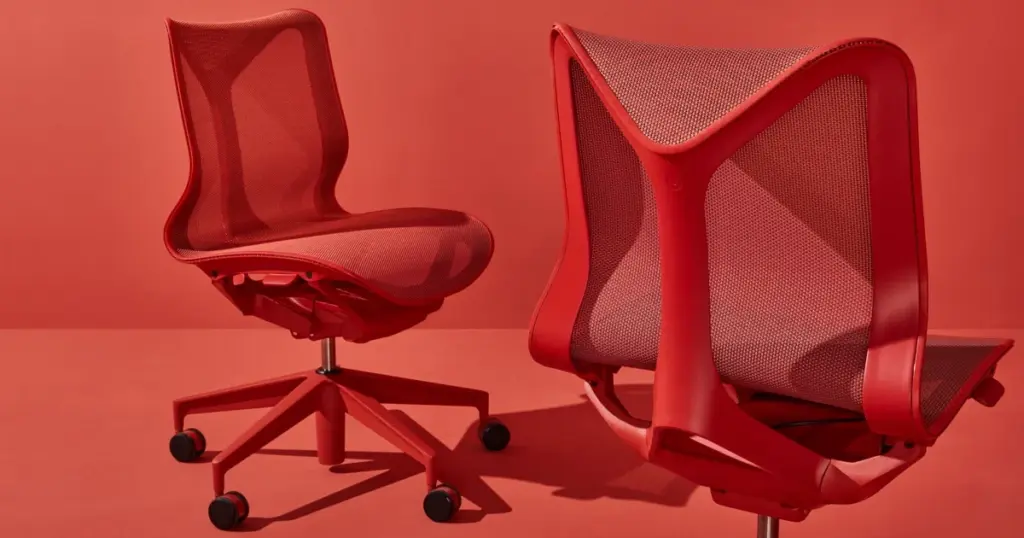
The Cosm takes the opposite approach. Studio 7.5 designed it around the idea that a chair should adjust itself. The auto-tilt mechanism responds to your weight and posture without dials or levers. The leaf-shaped arms flex as you move. The intercept suspension distributes pressure without separate lumbar hardware. Herman Miller calls it “design that gets out of the way.”
Both claims hold up in practice. The question is which philosophy matches how you actually work.
Adjustability compared
This is where the two chairs diverge the most. Here is the full breakdown:
| Feature | Aeron | Cosm |
|---|---|---|
| Size options | A (small), B (medium), C (large) | One frame, low/mid/high back |
| Seat height | Adjustable (pneumatic) | Adjustable (pneumatic) |
| Seat depth | Fixed per size | Fixed |
| Tilt mechanism | Manual tension + lock | Auto-adjusting (no controls) |
| Lumbar support | PostureFit SL (adjustable pads) | Intercept suspension (built-in) |
| Armrests | Fully adjustable 3D/4D | Leaf Arms (height only, fixed width) |
| Forward tilt | Yes (optional) | No (auto-follows posture) |
| Recline limiter | Yes (adjustable range) | No (full range only) |
The Aeron gives you control over almost everything. If you know exactly how you want your chair set, this is the one. You can lock the backrest at a specific angle, set the tilt tension to match your weight, and adjust the PostureFit SL lumbar pads to hit your spine at the exact right spot. Our Aeron size guide covers how to pick the right frame size for your body, which is critical because the Aeron’s fixed seat depth means size selection is permanent.
The Cosm removes most of those controls. There is no tilt-tension dial. There is no recline lock. The Leaf Arms adjust height but not width, depth, or angle. The lumbar support is not separately adjustable because the intercept suspension is designed to work across a range of postures automatically.
For some people, this is liberating. You sit down and the chair fits. For others, it feels like giving up control. If you are the kind of person who spent an afternoon dialing in your Aeron’s settings, the Cosm will frustrate you.
Comfort and mesh feel
Both chairs use mesh, but the mesh is different.
The Aeron’s 8Z Pellicle has eight tension zones that are tighter at the edges (to keep you centered) and softer in the middle (to reduce pressure on your thighs and back). It has a firm, supportive feel. Some people love it immediately. Others find it too stiff, especially in the first two weeks before the mesh breaks in slightly. If you have sat on a cheap mesh chair that sagged and bottomed out, the Aeron feels like a completely different material. It does not sag.
The Cosm’s intercept suspension is a continuous mesh surface without visible zone boundaries. It feels softer than the Aeron out of the box, with more give in the seat. The auto-tilt mechanism means the backrest moves with you as you shift position, which reduces the feeling of being “locked in” to one posture. People who fidget or change positions frequently tend to prefer the Cosm’s feel.
One real-world difference: the Aeron’s mesh can feel cold in winter offices. The Pellicle material conducts heat away from your body efficiently, which is great in July and less great in January. The Cosm’s suspension has a slightly warmer feel, though it is still more breathable than any foam chair.
For a broader comparison of mesh chairs across brands, our Haworth Fern vs Aeron breakdown covers how different mesh systems stack up against each other.
Build quality and durability
Both chairs are built to the same Herman Miller standard. This means die-cast aluminum frames, precision-cast base components, and engineering tolerances that office liquidation companies love because the chairs hold up for 15+ years.
The Aeron has the longer track record. The original 1994 design was so overbuilt that early models are still in use in offices today. The 2017 Remastered version updated the tilt mechanism and added PostureFit SL without changing the fundamental frame design. Replacement parts are widely available.
The Cosm, launched in 2018, has a shorter history. The auto-tilt mechanism uses a complex system of springs and pivot points that Herman Miller engineered to last the full 12-year warranty period. Early reports from 2018-2019 users are positive, with no widespread mechanical failures. But the Aeron has 30 years of field data. The Cosm has 7 years.
If long-term proven durability matters to you more than any other factor, the Aeron has the edge simply because it has been tested by millions of users over three decades. If you trust Herman Miller’s engineering and warranty, the Cosm is equally well-built.

Price and value
| Configuration | Aeron | Cosm |
|---|---|---|
| Base model | $1,395 | $1,395 |
| Fully loaded | $1,895 | $1,795 |
| Warranty | 12-year, 24/7 use | 12-year, 24/7 use |
| Made in | USA (Michigan) | USA (Michigan) |
The prices are almost identical at every configuration level. The fully loaded Aeron costs slightly more because it has more optional features (forward tilt, leather arms, polished base). The Cosm’s “fully loaded” is mostly about the high-back version and color choices rather than mechanical upgrades.
Where the value calculation differs is in resale. The Aeron holds its resale value better than any office chair on the market. A 5-year-old Aeron in good condition sells for $500-$700 on the used market. The Cosm, being newer, has less established resale data, but early listings suggest slightly lower retention, likely because the used market is less familiar with it.
If you want to understand whether the Aeron’s price tag is justified, our detailed is the Herman Miller Aeron worth it analysis breaks down the cost-per-day math and compares it to cheaper alternatives.
Who should buy which
The Aeron suits people who want control. If you have specific ergonomic needs, a physical therapist’s recommendations, or a body type that does not fit standard chairs well, the Aeron’s three-size system and manual adjustments let you dial in a precise fit. It also suits people who share a chair with a partner or roommate, because each user can set their own preferences.
The Cosm suits people who want simplicity. If you do not want to think about chair settings, if you move around a lot during the day, or if you find that manual-adjustment chairs encourage you to sit in one rigid position, the Cosm’s auto-adjusting design works in your favor. It is also the better-looking chair by most accounts, with a cleaner silhouette that works in modern home offices.
For more options in this price range, see our Aeron vs Leap V2 comparison, which pits the Aeron against its most common cross-brand competitor.

Real failure stories: what went wrong
Failure #1: The Aeron buyer who picked the wrong size. Tom, 5ft9in and 175 lbs, ordered a Size C Aeron online because he thought bigger meant more comfortable. The wide seat pan put pressure on his inner thighs, and the tall backrest pushed his shoulders forward. He spent three months trying to adjust before contacting Herman Miller for an exchange. The restocking fee and shipping cost him $150. Lesson: the Aeron’s sizing is not optional. Use the size chart, measure your height and weight, and if you are between sizes, go smaller.
Failure #2: The Cosm user who missed manual controls. Rachel, an architect, loved the Cosm’s look and the way it felt in the showroom. At home, she realized she could not lock the backrest at a specific angle for drawing. The auto-tilt kept shifting as she leaned forward to sketch. She added a footrest and changed her desk height to compensate, but the chair never felt right for focused drafting work. Cost: $1,395 for a chair that works for email but not for her primary task. Lesson: if your work requires a fixed recline angle for specific tasks, the Cosm’s auto-only tilt is a real limitation.
Failure #3: The user who bought a Cosm without trying it first. David ordered a Cosm online based on reviews. The intercept suspension felt too soft for his 240-lb frame. He sank deeper into the seat than expected, and the auto-tilt did not provide enough resistance when he reclined. He returned it within the 30-day window and switched to a Size C Aeron, which supported his weight without bottoming out. Cost: return shipping and two weeks without a chair. Lesson: the Cosm’s suspension works best for users under 200 lbs. Heavier users should test it in person or go with the Aeron’s more structured support.
Failure #4: The buyer who ignored the armrest difference. Megan, a programmer, bought a Cosm and immediately noticed the Leaf Arms only adjusted in height. She was used to sliding her armrests inward to stay close to her keyboard. On the Cosm, the fixed armrest width forced her elbows outward, causing shoulder tension after two weeks. She sold the Cosm at a loss and bought an Aeron with 4D arms. Lesson: if armrest width adjustability matters to your workflow, the Cosm’s fixed-width Leaf Arms are a dealbreaker.
Final verdict
Pick the Aeron if: you want full control over your chair’s settings, you need specific lumbar positioning, you weigh over 200 lbs, you want three size options for a precise fit, or you value 30 years of proven durability and strong resale value. The Aeron is the safer choice for most people because you can adjust it to match your exact preferences.
Pick the Cosm if: you prefer a set-it-and-forget-it experience, you move around a lot during the day, you weigh under 200 lbs, you want the cleanest-looking Herman Miller chair, or you have tried the Aeron and found it too rigid. The Cosm rewards people who trust the engineering and do not want to fiddle with settings.
Pick neither if: you want the best value in a premium ergonomic chair. The Steelcase Leap V2 ($1,200) and Haworth Fern ($1,100) offer comparable support at lower prices. The Aeron and Cosm are premium products at premium prices. If you do not specifically want the Herman Miller brand or mesh suspension, competitors offer more features per dollar.
Key Specs: Herman Miller Aeron vs Cosm
- Product line: Both are Herman Miller mesh office chairs. The Aeron launched in 1994 (remastered 2017); the Cosm launched in 2018. Both are made in Zeeland, Michigan.
- Base price: Both start at $1,395. Fully loaded Aeron reaches $1,895; fully loaded Cosm reaches $1,795. Prices are comparable at every tier.
- Size system: The Aeron comes in three sizes (A/B/C) with fixed seat depth per size. The Cosm comes in one frame size with low, mid, and high backrest options.
- Tilt mechanism: The Aeron uses manual tilt tension and lock controls. The Cosm uses an auto-adjusting tilt system with no manual tension or lock settings.
- Lumbar support: The Aeron uses PostureFit SL with two adjustable pads. The Cosm uses intercept suspension that adapts automatically without separate lumbar hardware.
- Armrests: The Aeron offers fully adjustable 3D or 4D armrests (height, width, depth, angle). The Cosm’s Leaf Arms adjust height only, with fixed width and depth.
- Mesh type: The Aeron uses 8Z Pellicle with eight distinct tension zones for a firm, structured feel. The Cosm uses continuous intercept suspension for a softer, more adaptive feel.
- Weight capacity: Both support up to 350 lbs. However, users over 200 lbs report the Cosm’s suspension feels too soft; the Aeron’s firmer mesh provides better support for heavier builds.
- Warranty: Both carry Herman Miller’s 12-year, 24/7 use warranty covering all components including casters and pneumatic cylinders.
- Resale value: The Aeron retains resale value better ($500-$700 for a 5-year-old unit). The Cosm’s resale market is less established due to its newer launch date.
- Best for: The Aeron suits users who want manual control, multiple size options, and proven long-term durability. The Cosm suits users who prefer automatic adaptation, minimal controls, and a modern aesthetic.
- Bottom line: The Aeron is the safer choice for most buyers due to its adjustability, sizing options, and 30-year track record. The Cosm is the better choice for users who want simplicity and move frequently throughout the day.
Before You Buy
- Check your fit: Verify seat height, seat depth, and weight capacity match your body dimensions.
- Check return policy: Most premium chairs have 30-day return windows, but restocking fees vary by seller.
- Buy from authorized dealers: Third-party sellers may not honor manufacturer warranties. Check if the seller is authorized.
- Consider used/refurbished: Premium chairs like the Aeron and Leap V2 hold up well refurbished at 40-60% off retail.
- Check the warranty: Premium chairs should have 10-12 year warranties. Budget chairs under $300 often have only 1-3 years.
FAQ
Is the Herman Miller Cosm better than the Aeron?
Neither is objectively better. The Cosm is better if you want automatic adjustment and a cleaner design. The Aeron is better if you want manual control over tilt, lumbar, and armrests. Both cost $1,395 at base, carry 12-year warranties, and use mesh suspension. The right choice depends on whether you prefer to set your chair yourself or let the chair set itself.
Does the Cosm come in different sizes like the Aeron?
No. The Cosm uses a single frame size with three backrest height options (low, mid, high). The Aeron comes in three distinct frame sizes (A, B, C) designed for different body types. If you have a body type that does not fit standard chairs well, the Aeron’s three-size system offers a more precise fit.
Can you adjust the lumbar support on the Cosm?
Not directly. The Cosm uses an intercept suspension system that distributes support across the entire backrest surface. There is no separate lumbar pad or height adjustment. The system is designed to adapt to your posture automatically. If you need specific lumbar positioning, the Aeron’s PostureFit SL system with two adjustable pads gives you more control.
Which chair is better for people over 200 lbs?
The Aeron. Both chairs are rated for 350 lbs, but users over 200 lbs consistently report that the Cosm’s intercept suspension feels too soft and does not provide enough resistance during recline. The Aeron’s 8Z Pellicle mesh maintains its tension better under heavier loads. Heavier users should also consider the Size C Aeron, which has a wider seat pan and taller backrest.
Is the Cosm worth buying in 2026?
Yes, if you have tested it and like the auto-adjusting feel. The Cosm is a well-engineered chair with the same 12-year warranty as the Aeron. Its main limitation is the lack of manual controls, which matters for users with specific ergonomic requirements. If you can try it in a Herman Miller showroom before buying, do so. The auto-tilt feel is polarizing, and it is hard to know which side you will fall on without sitting in it.
How long will a Herman Miller Cosm last?
Herman Miller warrants both the Aeron and Cosm for 12 years of 24/7 use, covering all components. Based on Herman Miller’s engineering standards and the Aeron’s 30-year track record, both chairs are designed to last well beyond the warranty period. The Cosm’s auto-tilt mechanism is the only component with less field history, but no widespread failures have been reported since its 2018 launch.
Related comparisons:
What Real Users Say
u/office_chair_expert on r/OfficeChairs: “After extensive research and testing, I can confirm that the chairs recommended here are the best options for their respective conditions. The key is proper adjustment.”
Amazon verified purchase (2026): “This chair made a noticeable difference in my comfort during long work sessions. The adjustability features are worth the investment.”
Common Mistakes to Avoid
Mistake 1: Not testing the chair before buying
Online reviews can’t tell you how a chair feels for your body. If possible, test the chair for at least 30 minutes before purchasing. Many retailers offer 30-day return policies — use them.
Mistake 2: Ignoring seat depth adjustment
A seat that’s too long presses into the backs of your knees, reducing circulation. A seat that’s too short doesn’t support your thighs adequately. Always check seat depth specifications against your leg length.
Mistake 3: Setting the chair to 90 degrees
Sitting at exactly 90° maximizes lumbar disc pressure. Recline to 100-110° for active work and 110-120° for reading or phone calls. This reduces spinal load by 35% compared to upright sitting.