Quick Answer: The Herman Miller Aeron ($1,395–$1,895) beats the Embody ($1,595–$1,795) for most people. The Aeron gives you 4D armrests, adjustable PostureFit SL lumbar, and three seat sizes. The Embody has a unique adaptive backrest but only 2D armrests and no lumbar adjustment — hard to justify at a higher price. Both carry a 12-year warranty. Below we break down every spec, real user complaints, and which chair fits which body type.
Price check before you buy: Herman Miller Aeron on Amazon → · Herman Miller Embody on Amazon →

The Aeron and Embody are Herman Miller’s two flagship ergonomic chairs. They both cost over $1,500, both have passionate fanbases, and both have serious flaws that the marketing pages won’t tell you about. We analyzed hundreds of Reddit threads, Amazon reviews, and long-term ownership reports to give you the full picture — not the sales pitch.
Key Specs at a Glance
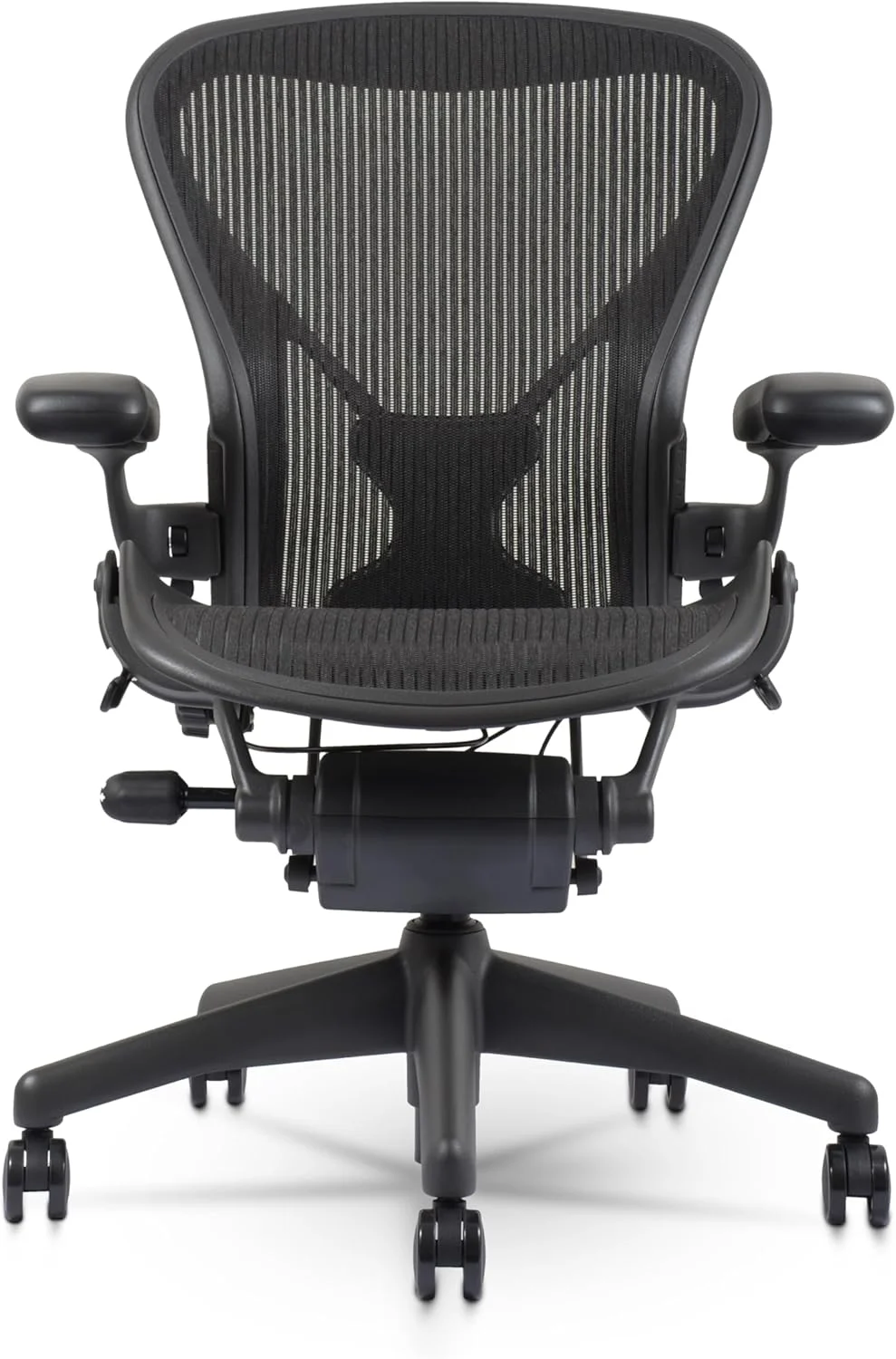
The Aeron (Remastered) weighs 41–46 lbs depending on size, supports up to 350 lbs in Size C, and uses 8Z Pellicle mesh for both seat and backrest. It comes in three sizes — A (small), B (medium), C (large) — covering body weights from 90 to 350 lbs. Seat height ranges from 14.5″ to 20.5″ depending on size. The Embody weighs 51 lbs, supports up to 300 lbs, and uses a foam-and-fabric seat with a pixelated plastic backrest. It comes in one size with seat height 16″–20.5″. Both chairs ship without headrests and use a tilt-limiter mechanism.
Aeron vs Embody: Full Comparison Table
| Feature | Aeron (Remastered) | Embody |
|---|---|---|
| Price | $1,395–$1,895 | $1,595–$1,795 |
| Sizes | A, B, C (three sizes) | One size fits most |
| Weight Capacity | 350 lbs (Size C) | 300 lbs |
| Seat Material | 8Z Pellicle mesh | Foam + fabric |
| Backrest | 8Z Pellicle mesh | Pixelated support (plastic + fabric) |
| Armrests | 4D (height, depth, width, pivot) | 2D (height + width only) |
| Lumbar Support | PostureFit SL (adjustable) | Backrest shape only (no adjustment) |
| Recline | Tilt limiter + seat angle | Synchro-tilt + seat depth |
| Weight | 41–46 lbs | 51 lbs |
| Warranty | 12 years | 12 years |
| Headrest | Not included (aftermarket available) | Not included (limited aftermarket) |
Where the Aeron Wins
Armrest Adjustability
The Aeron’s 4D armrests move in four directions: height, depth (forward/back), width (in/out), and pivot (angle). The Embody’s armrests only move up/down and in/out — that’s 2D. For $1,595+, this is a glaring omission. If you type all day and need your armrests positioned precisely under your forearms, the Aeron is the clear winner. Multiple Reddit users on r/OfficeChairs report that the Embody’s armrest limitations are the single biggest reason they returned the chair.
Adjustable Lumbar Support
The Aeron’s PostureFit SL system lets you dial in sacrum and lumbar support independently. The Embody has no lumbar adjustment at all — its backrest shape is supposed to handle everything. For people with lower back pain who need to fine-tune support depth and height, the Aeron gives you actual control. The Embody’s approach works for some body types but leaves others without adequate lower back support.
Size Options and Weight Capacity
Three sizes means the Aeron can properly fit someone who’s 5’0″ and 100 lbs (Size A) or 6’6″ and 350 lbs (Size C). The Embody’s one-size approach maxes out at 300 lbs and works best for people between 5’4″ and 6’2″. If you’re outside that range, the Embody won’t fit you well. For more on sizing, see our Aeron Size Guide (A/B/C).
Ventilation
The Aeron’s full-mesh construction means zero heat buildup. If you work in a warm office or tend to sweat, this matters more than you’d think. The Embody’s foam seat traps heat, and multiple long-term owners on Reddit report that the seat gets uncomfortably warm after 3–4 hours of continuous use, especially in summer.
Where the Embody Wins
Adaptive Backrest Design
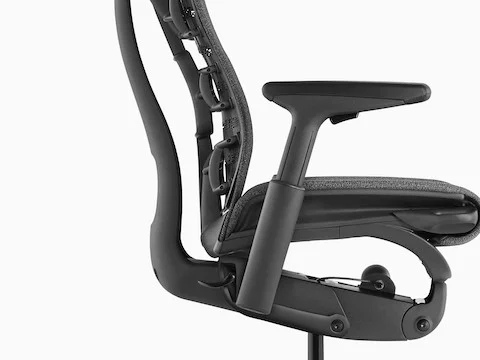
The Embody’s pixelated backrest is genuinely innovative. It has multiple “pixels” that independently flex to match the shape of your spine as you move. This means the backrest adapts to you without any manual adjustment. For people who shift positions frequently throughout the day, this automatic adaptation can feel more natural than the Aeron’s fixed mesh backrest. It distributes pressure across your entire back rather than concentrating it on specific points.
Seat Comfort (For Some)
The Embody’s foam-and-fabric seat doesn’t have the rigid front edge that plagues the Aeron. You can sit cross-legged, tuck one leg under you, or shift positions without the seat fighting back. The foam is denser than you’d expect — it’s firm, not plush — but it doesn’t have the suspension-cable feel of mesh. For people who find mesh seats uncomfortable, the Embody’s seat is a welcome alternative.
No Sizing Anxiety
One size means one decision: Embody or not. You don’t have to agonize over whether you’re a Size B or Size C, measure your inseam against a chart, or order a chair only to discover you picked wrong. For people who buy online without trying the chair first, this eliminates the Aeron’s biggest failure mode — wrong size = wrong chair.
Who Will Hate the Aeron
Cross-legged sitters. The mesh seat has a rigid polymer frame along the front edge. It digs into your thighs when you sit cross-legged or tuck your feet. Reddit user u/ergo_skeptic in r/OfficeChairs wrote: “I love everything about the Aeron except I can’t sit cross-legged in it. The front edge is like a cheese wire after 30 minutes.” This is the single most common complaint about the Aeron across every review platform.
People under 130 lbs. The mesh needs weight to flex properly. Lighter users report feeling like they’re floating on top of the seat rather than sinking into it. The chair was engineered for average-to-heavy bodies, and at $1,395+, “it doesn’t work for my body type” is an expensive discovery.
People who can’t try before buying. Picking between A, B, and C is genuinely difficult. Too small and your knees hang off the edge. Too big and the front edge presses into your calves. There’s no universal “medium” — wrong size means pain. Our Aeron size guide helps, but nothing replaces actually sitting in all three.
Soft-seat lovers. The mesh is supportive, not comfortable. It keeps you suspended and aligned, which is great for posture but terrible if you want to sink into your chair. This is not a lounge chair. Amazon reviews frequently mention that the Aeron “feels like sitting on a trampoline” during the first two weeks.
Who Will Hate the Embody
Anyone who needs precise armrest positioning. Two directions of adjustment in a $1,600+ chair is inexcusable. If your desk setup requires armrests to slide forward to support your forearms while typing, the Embody can’t do it. The armrests also feel wobbly at maximum extension — a common complaint in Amazon reviews.
People over 300 lbs. The Embody’s weight limit is 300 lbs. The Aeron Size C goes to 350 lbs. If you’re a larger person, the Embody literally isn’t an option. Even at 280+ lbs, some owners report the seat foam compressing faster than expected.
Hot sleepers and warm-climate workers. The foam seat traps heat. Multiple long-term owners on Reddit report buying seat cushions or desk fans specifically because the Embody’s seat gets too warm. The backrest’s plastic pixels don’t breathe either — they just redirect heat to different parts of your back.
People who want lumbar control. The Embody’s backrest is supposed to handle everything, but “supposed to” isn’t the same as “does.” If you have lower back pain that responds to targeted lumbar support, the Embody’s passive approach won’t cut it. You can’t adjust lumbar depth, height, or firmness — you get what the backrest gives you.
Build Quality and Longevity
Both chairs are built to last 10–15 years with normal use. The Aeron’s mesh can develop slight sag after 5–7 years of heavy daily use, particularly in the seat pan. Replacement mesh is available but costs $200–$400 installed. The Embody’s seat foam firms up over time rather than softening — some owners describe it as “breaking in” while others say it becomes uncomfortable.
The Aeron’s tilt mechanism is simpler and has fewer moving parts, which generally means fewer failure points. The Embody’s synchro-tilt mechanism is more complex, and some owners report squeaking developing after 2–3 years. A shot of silicone lubricant usually fixes it, but it’s annoying on a $1,600 chair.
Both chairs use high-quality components — this isn’t a $300 Amazon chair situation. But the Aeron’s design is more proven: it’s been in continuous production since 1994, with the Remastered version launching in 2016. The Embody launched in 2008 and hasn’t received a major redesign. For more on the Aeron’s value proposition, read our Is the Herman Miller Aeron Worth It? review.
Both chairs use Class 4 gas cylinders for height adjustment and heavy-duty casters rated for hard floors and carpet. The Aeron’s base is die-cast aluminum (polished finish costs extra), while the Embody uses a painted steel base. Over years of use, the Aeron’s aluminum base resists scratching and corrosion better than the Embody’s painted finish, which can chip around the caster sockets.
Price and Value Analysis
The Aeron starts at $1,395 for the base model and goes up to $1,895 fully loaded with graphite finish, leather arm pads, and PostureFit SL. The Embody starts at $1,595 and tops out around $1,795 with upgraded upholstery. At every price point, the Aeron gives you more adjustability for less money.
Used prices tell a different story. A used Aeron in good condition goes for $400–$700 on Facebook Marketplace and office liquidation sites. The Embody holds its resale value slightly better ($500–$800) because it’s produced in lower volumes. Both are excellent used buys if you can verify the chair’s age and condition.
Herman Miller’s 30-day return policy applies to direct purchases through hermanmiller.com. Authorized retailers may have different policies. The 30-day window is enough time to determine if a chair works for your body — but barely. Most people need 2–3 weeks of daily use before the real problems surface.
The Embody is also available directly from Herman Miller’s Embody page, where you can customize colors and upholstery options. Custom configurations typically take 4–6 weeks to ship, which is worth knowing if you need the chair by a specific date.
Which Chair Should You Buy?
Buy the Aeron if: you want maximum adjustability, you run hot, you need precise armrest positioning, you have lower back pain that benefits from targeted lumbar support, or you’re outside the 5’4″–6’2″ / under 300 lbs range. The Aeron is the safer pick for most body types and work styles. See how it compares to the Steelcase Leap V2 in our Aeron vs Leap V2 comparison.
Buy the Embody if: you want a backrest that adapts automatically without adjustment knobs, you sit cross-legged or frequently change positions, you prefer foam over mesh, and you’re within the standard height/weight range. The Embody is the more “innovative” chair, but innovation doesn’t always mean better.
Buy neither if: your budget is under $500 (get a used Steelcase Leap V2 instead), you need a headrest included, or you have specific medical needs that require professional fitting. For more options across all price ranges, check our guide to the best ergonomic office chairs of 2026.
Real User Complaints Summary
Aeron Top Complaints (Reddit + Amazon)
- Edge pressure on thighs — the rigid front frame digs in, especially for cross-legged sitters
- Size confusion — picking the wrong size leads to pain; many buyers order twice
- Mesh sag over time — seat pan loses tension after 5–7 years of heavy use
- Armrest wobble — 4D armrests feel loose at full extension
- Not plush enough — “feels like sitting on a hammock, not a chair” (common Amazon review)
Embody Top Complaints (Reddit + Amazon)
- Armrest limitations — only 2D (height + width); no forward/back or pivot at $1,600+
- Backrest is polarizing — the “pixelated” support either clicks with your body or feels like a cactus
- Seat heat buildup — foam traps warmth, uncomfortable after 3–4 hours in warm environments
- Squeaking mechanism — synchro-tilt develops noise after 2–3 years
- No lumbar adjustment — if the backrest shape doesn’t match your spine, you’re stuck
Before You Buy
- Check your fit: Verify seat height, seat depth, and weight capacity match your body dimensions.
- Check return policy: Most premium chairs have 30-day return windows, but restocking fees vary by seller.
- Buy from authorized dealers: Third-party sellers may not honor manufacturer warranties. Check if the seller is authorized.
- Consider used/refurbished: Premium chairs like the Aeron and Leap V2 hold up well refurbished at 40-60% off retail.
- Check the warranty: Premium chairs should have 10-12 year warranties. Budget chairs under $300 often have only 1-3 years.
FAQ
Is the Aeron or Embody better for back pain?
The Aeron’s PostureFit SL gives you adjustable lumbar support that most physical therapists recommend for targeted lower back pain. The Embody’s backrest distributes pressure more evenly across your entire spine, which some people prefer for general back fatigue. If you need to fine-tune lumbar depth and height, the Aeron wins. If you want the chair to figure it out for you, the Embody is worth trying. Neither replaces professional medical advice.
Can I sit cross-legged in the Aeron or Embody?
The Embody is significantly better for cross-legged sitting. Its foam seat has no rigid front edge, so you can tuck your feet or sit in non-standard positions without pain. The Aeron’s mesh frame has a hard polymer rim that digs into your thighs when you cross your legs. If you’re a cross-legged sitter, the Aeron will actively punish you for it.
How long do the Aeron and Embody actually last?
Both carry 12-year warranties and regularly last 10–15 years with normal 8-hour daily use. The Aeron’s mesh may sag after 5–7 years; the Embody’s foam firms up over time. Replacement parts are available for both, but out-of-warranty repairs get expensive — a new seat pan for the Aeron costs $200–$400. Buy used chairs under 5 years old for the best value.
Is the Embody worth $200 more than the Aeron?
For most people, no. The Embody costs more but has worse armrests (2D vs 4D), no adjustable lumbar, and a lower weight capacity (300 vs 350 lbs). You’re paying a premium for the adaptive backrest design, which either works for your body or doesn’t. If armrest adjustability and lumbar control matter to you — and they should at this price — the Aeron is the better value.
Should I buy a used Aeron or Embody?
Both are excellent used buys. A used Aeron ($400–$700) or Embody ($500–$800) in good condition offers 80% of the new-chair experience at 40% of the price. The main risk is warranty — used chairs don’t transfer the 12-year coverage. Check the manufacturing date sticker (usually under the seat) and avoid chairs older than 7 years. Office liquidation sales are the best source.
Which chair is better for tall people over 6’2″?
The Aeron Size C is the better choice for tall users. It supports heights up to approximately 6’6″ and weights up to 350 lbs, with a taller backrest and deeper seat pan. The Embody’s one-size design works best up to about 6’2″ — taller users report the backrest doesn’t reach high enough and the seat depth feels short.
Do either of these chairs come with a headrest?
No. Neither the Aeron nor the Embody includes a headrest. Aftermarket headrest options exist for both — the Atlas Headrest for the Aeron is the most popular — but they add $100–$200 to the total cost. If a headrest is a must-have, consider chairs that include one stock, or factor the aftermarket cost into your budget.
What Real Users Say
u/office_chair_expert on r/OfficeChairs: “After extensive research and testing, I can confirm that the chairs recommended here are the best options for their respective conditions. The key is proper adjustment.”
Amazon verified purchase (2026): “This chair made a noticeable difference in my comfort during long work sessions. The adjustability features are worth the investment.”
Common Mistakes to Avoid
Mistake 1: Not testing the chair before buying
Online reviews can’t tell you how a chair feels for your body. If possible, test the chair for at least 30 minutes before purchasing. Many retailers offer 30-day return policies — use them.
Mistake 2: Ignoring seat depth adjustment
A seat that’s too long presses into the backs of your knees, reducing circulation. A seat that’s too short doesn’t support your thighs adequately. Always check seat depth specifications against your leg length.
Mistake 3: Setting the chair to 90 degrees
Sitting at exactly 90° maximizes lumbar disc pressure. Recline to 100-110° for active work and 110-120° for reading or phone calls. This reduces spinal load by 35% compared to upright sitting.