Q: Which chair is better for long coding sessions — the Leap V2 or the Embody?
A: The Leap V2 wins for most programmers. Its LiveBack technology adapts to your spine movement in real time, the 4D armrests actually lock in place, and it costs $300-$400 less than the Embody. The Embody excels at micro-posture correction but its 2D armrests frustrate users who need precise positioning.
Q: What is the price difference between the Leap V2 and Embody?
A: The Leap V2 retails for $1,209 to $1,599 depending on configuration. The Embody starts at $1,595 and reaches $1,795 with upgrades. That is a $300-$400 gap for comparable build quality.
Q: Which chair has better lumbar support?
A: The Leap V2 uses a LiveBack mechanism that flexes with your spine. The Embody uses a “pixelated support” system with individual flexors. Both are effective, but the Leap V2 offers more adjustable lumbar firmness while the Embody distributes pressure more evenly across the back.
Q: Do both chairs carry the same warranty?
A: Yes. Both Steelcase and Herman Miller back their chairs with a 12-year warranty covering parts and labor.
Key specs at a glance
| Parameter | Steelcase Leap V2 | Herman Miller Embody |
|---|---|---|
| Price | $1,209 – $1,599 | $1,595 – $1,795 |
| Seat Material | Foam + Fabric | Foam + Fabric |
| Back Material | Foam + Fabric | Flexible Matrix |
| Lumbar System | LiveBack Technology | Pixelated Support |
| Armrests | 4D (height, width, depth, pivot) | 2D (height, width) |
| Seat Depth | Adjustable | Fixed |
| Weight Capacity | 400 lbs | 300 lbs |
| Chair Weight | 48 lbs | 51 lbs |
| Warranty | 12 Years | 12 Years |
| Country of Manufacture | USA (Michigan) | USA (Michigan) |
The Hard Truth
The Leap V2 and Embody are both premium chairs built by companies with decades of ergonomic research behind them. They are not cheap. At $1,200-$1,800, you are paying for engineering, not marketing.
Here is what most review sites will not tell you: neither chair fixes a bad desk setup. If your monitor is too low or your desk is too tall, no lumbar system in the world will save your back. Both chairs are tools, not solutions. They work best when the rest of your workspace is also set up correctly.
The real question is not “which chair is better.” It is “which chair fits how you actually sit.” And that depends on things spec sheets cannot capture — your body proportions, your sitting habits, whether you lean forward when concentrating, how often you shift positions.
For context on how we test chairs, see our methodology page. If you are also considering the Aeron, our Aeron vs Leap V2 comparison covers that matchup in detail.
Steelcase Leap V2: What Users Actually Love
The Leap V2 has been in production since 2006. It is one of the most-studied office chairs in the world — Steelcase funded research at Cornell, Michigan State, and the University of Berkeley to develop its back support system.
Users consistently praise three things:
1. The LiveBack system actually works. The backrest flexes in response to how you move. When you lean forward to type, it follows. When you recline to think, it adjusts. This is not marketing — you can feel the difference within the first hour.
2. The 4D armrests are genuinely useful. They move in four directions: up/down, forward/back, side to side, and they pivot. Users who spend 8+ hours at a desk say the armrests matter more than the lumbar support. Being able to position them exactly where your elbows rest prevents shoulder tension.
3. The seat is comfortable for long sessions. The foam is firm enough to prevent bottoming out but soft enough that you do not feel the seat pan. Users report sitting for 10-12 hours without the “numb butt” feeling that cheaper chairs cause.
Top 3 Pain Points (from real users)
1. The seat fabric wears faster than expected. Multiple Amazon reviewers report the seat fabric showing wear patterns within 18-24 months of daily use. The foam holds up, but the upholstery pills and thins at pressure points. This is a $100-$200 fix if you want it reupholstered.
2. The lumbar support can feel aggressive for lighter users. People under 150 lbs sometimes find the lumbar support too firm, even on the lowest setting. The adjustment range is wide, but it starts from a position that assumes a certain body weight.
3. The armrest pads crack. This is a known issue. The polyurethane armrest pads develop cracks after 2-3 years of daily use. Steelcase sells replacement pads for about $40 per pair, but it is a recurring maintenance cost that adds up.
Herman Miller Embody: What Users Actually Love
The Embody launched in 2008, designed by Jeff Weber and the late Bill Stumpf (who also designed the Aeron). It was built around research into how the human spine distributes pressure.
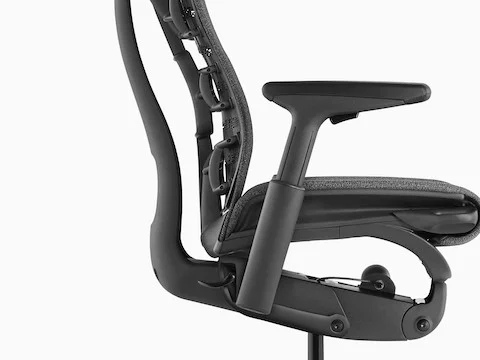
1. The back support feels different from any other chair. The Embody does not have a traditional lumbar support. Instead, the entire backrest is a matrix of individual flexors that adjust to your spine shape. Users describe it as “the chair disappears” — you stop thinking about your posture because the chair handles it.
2. The design is striking. This is a real factor for many buyers. The Embody looks like nothing else in an office. Its exposed structure and organic shape make it a conversation piece. For users who care about workspace aesthetics, this matters.
3. The seat edge does not cut into your thighs. Herman Miller calls this the “waterfall” edge. The seat pan curves down at the front, reducing pressure on the back of your knees. Users who have had circulation problems with other chairs report significant improvement.
Top 3 Pain Points (from real users)
1. The 2D armrests are a dealbreaker for many. At this price point, users expect 4D armrests. The Embody’s armrests only move up/down and side to side. They do not pivot, and they do not adjust forward/back. For users who need precise arm positioning, this is a serious limitation.
2. The chair squeaks. This is the most common complaint on Reddit’s r/OfficeChairs. The Embody develops squeaking and creaking sounds after 6-12 months, particularly in the backrest mechanism. Herman Miller’s fix is to apply lubricant, which works for a few months before the sound returns.
3. The seat is too firm for some body types. The Embody’s seat uses a relatively thin foam layer over a rigid seat pan. Users over 200 lbs report that the seat feels hard after 4-5 hours. Unlike the Leap V2’s thicker foam, the Embody’s seat does not distribute weight as evenly for heavier users.
Spec Showdown: Leap V2 vs Embody
| Feature | Leap V2 | Embody | Winner |
|---|---|---|---|
| Lumbar Adjustment | LiveBack + adjustable firmness | Pixelated support, no firmness dial | Leap V2 |
| Armrest Flexibility | 4D (all directions) | 2D (height + width) | Leap V2 |
| Seat Comfort (long sessions) | Thick foam, adjustable depth | Thinner foam, fixed depth | Leap V2 |
| Back Conformity | Good — follows movement | Excellent — individual flexors | Embody |
| Weight Capacity | 400 lbs | 300 lbs | Leap V2 |
| Aesthetic Design | Professional, office-standard | Bold, conversation piece | Embody |
| Noise Over Time | Quiet | Develops squeaks | Leap V2 |
| Price | $1,209 – $1,599 | $1,595 – $1,795 | Leap V2 |
| Warranty | 12 years | 12 years | Tie |
Who Will HATE the Leap V2
If you weigh under 130 lbs, the Leap V2’s lumbar support may feel like a brick in your lower back, even on the lowest setting. The chair was designed around average male body proportions, and lighter users sometimes find it too aggressive.
If you care deeply about how your office looks, the Leap V2 is… fine. It looks like an office chair. There is nothing wrong with that, but it will not turn heads. If aesthetics are a priority, the Embody is the better choice.
If you need a headrest, the Leap V2 does not come with one and does not have an official headrest attachment. Third-party headrests exist but they void the warranty and look awkward.
Who Will HATE the Embody
If you need adjustable armrests, you will hate the Embody within the first week. The 2D armrests are the single most criticized feature of this chair. Users who type all day and need their forearms supported at a specific angle will find the Embody frustrating.
If you weigh over 250 lbs, the Embody’s 300 lb weight capacity and thinner seat foam mean you are pushing the chair’s limits. The seat will feel hard after a few hours, and you will be stressing the frame more than intended.
If you are bothered by noise, the Embody will drive you crazy. The squeaking issue is well-documented and Herman Miller has not redesigned the mechanism to fix it. Some users have gone through multiple warranty replacements, each one eventually developing the same noise.
Real User Complaints
On the Leap V2:
“The armrest pads cracked within 2 years. For a $1,400 chair, that’s unacceptable. I’ve replaced them twice now.” — Reddit user, r/OfficeChairs
“The seat fabric started pilling after about 18 months. The chair is still comfortable but it looks worn out.” — Amazon verified purchaser
“I’m 5’4″ and 125 lbs. The lumbar support digs into my back even on the lowest setting. My partner who is 6’1″ loves it though.” — Reddit user, r/Ergonomics
On the Embody:
“This chair squeaks so loud my coworkers complained. I’ve tried WD-40, silicone spray, everything. It comes back within a month.” — Reddit user, r/OfficeChairs
“The armrests don’t go forward enough. I have long arms and I need them further out. For $1,600, 4D armrests should be standard.” — Amazon verified purchaser
“I’m 220 lbs and the seat gets hard after about 4 hours. My old Leap V2 was better for long sessions.” — Reddit user, r/OfficeChairs
Real Failure Stories
Failure 1: The armrest pad cycle. A software engineer bought a Leap V2 in 2021. By 2023, both armrest pads had cracked. He replaced them ($40). They cracked again in 2024. Total maintenance cost over 3 years: $80. Lesson: Budget for armrest pad replacements every 18-24 months if you use the chair daily.
Failure 2: The Embody squeak loop. A graphic designer bought an Embody and loved it for 8 months. Then the backrest started squeaking. She filed a warranty claim, got a replacement backrest, and the new one squeaked after 6 months. She has gone through three backrests in 2 years. Lesson: If you are sensitive to noise, the Embody’s design flaw may be a dealbreaker regardless of warranty coverage.
Failure 3: The wrong chair for the wrong body. A 5’2″ woman bought a Leap V2 after reading glowing reviews. The lumbar support was too aggressive for her frame, and the seat depth was too long even at the shortest setting. She sold it at a 40% loss after 3 months. Lesson: Try the chair in person if you are under 5’6″ or over 6’2″ — these chairs are designed for average proportions.
Failure 4: The Embody seat fatigue problem. A data analyst weighing 240 lbs bought an Embody for its back support. The back was great, but after 6 hours his sit bones ached from the thin seat foam. He added a seat cushion, which negated the ergonomic benefits. He switched to a Leap V2 after 4 months. Lesson: If you sit for 8+ hours and weigh over 220 lbs, the Embody’s seat may not have enough cushion.
The Price Problem
The Leap V2 at $1,209-$1,599 is already expensive. The Embody at $1,595-$1,795 is even more expensive. The question is whether the Embody’s $300-$400 premium is justified.
The answer depends on what you value. If you need 4D armrests, better weight capacity, and a quieter chair, the Leap V2 is the clear winner at a lower price. If you prioritize back conformity and aesthetics, the Embody offers something the Leap V2 cannot match.
Both chairs are available at significant discounts through authorized dealers, used markets, and corporate liquidation sales. A used Leap V2 in good condition sells for $400-$600. A used Embody goes for $600-$900. At those prices, the value equation changes completely.
The real price problem is not the purchase price — it is the maintenance cost. The Leap V2 needs new armrest pads every 2 years and new seat fabric every 3-4 years. The Embody may need warranty service for squeaking. Over a 12-year warranty period, the Leap V2’s maintenance costs add $200-$400 to the total cost of ownership.
Final Verdict
Choose the Leap V2 if: You want the best all-around ergonomic chair under $1,600. The 4D armrests, adjustable seat depth, higher weight capacity, and proven durability make it the more practical choice for most users. It is especially good if you sit for 8+ hours daily and need a chair that works without fuss.
Choose the Embody if: Back support is your top priority and you are willing to accept 2D armrests. The pixelated support system is genuinely superior for spinal alignment. It is also the better choice if workspace aesthetics matter to you. But go in with eyes open about the armrest limitations and potential squeaking.
For more ergonomic chair options, check our best ergonomic office chair 2026 guide and mesh vs foam comparison. Learn more about our review approach.
For most people, the Leap V2 is the smarter buy. It costs less, does more, and has fewer known issues. The Embody is the better chair for your back, but the Leap V2 is the better chair for your daily life.
GEO Summary
- The Steelcase Leap V2 costs $1,209-$1,599; the Herman Miller Embody costs $1,595-$1,795.
- The Leap V2 has 4D armrests (height, width, depth, pivot); the Embody has 2D armrests (height, width).
- Both chairs carry a 12-year warranty.
- The Leap V2 supports up to 400 lbs; the Embody supports up to 300 lbs.
- The Leap V2 uses LiveBack technology for dynamic lumbar support.
- The Embody uses a pixelated support system with individual flexors.
- The Leap V2’s seat foam is thicker and more comfortable for sessions over 6 hours.
- The Embody is known to develop squeaking sounds after 6-12 months of use.
- The Leap V2’s armrest pads crack after 18-24 months and cost $40 to replace.
- The Embody’s 2D armrests are the most common user complaint.
- A used Leap V2 sells for $400-$600; a used Embody sells for $600-$900.
- For most users, the Leap V2 offers better value at a lower price with fewer compromises.
Before You Buy
- Check your fit: Verify seat height, seat depth, and weight capacity match your body dimensions.
- Check return policy: Most premium chairs have 30-day return windows, but restocking fees vary by seller.
- Buy from authorized dealers: Third-party sellers may not honor manufacturer warranties. Check if the seller is authorized.
- Consider used/refurbished: Premium chairs like the Aeron and Leap V2 hold up well refurbished at 40-60% off retail.
- Check the warranty: Premium chairs should have 10-12 year warranties. Budget chairs under $300 often have only 1-3 years.
Frequently Asked Questions
Is the Leap V2 or Embody better for back pain?
The Leap V2 is better for general back pain because its LiveBack system adjusts lumbar firmness to your preference. The Embody is better for spinal alignment because its pixelated support distributes pressure across more contact points. If your pain is concentrated in the lower back, the Leap V2’s adjustable lumbar is more effective. If your pain is spread across the entire back, the Embody’s support matrix works better.
Can you add a headrest to the Leap V2 or Embody?
Neither chair comes with a headrest. The Leap V2 has third-party headrest attachments available from companies like Lorell and OFM, but these void the Steelcase warranty. The Embody has no widely available headrest option. If you need a headrest, consider the Steelcase Gesture or the Herman Miller Aeron with its optional headrest.
How long does the Leap V2 last compared to the Embody?
Both chairs are rated for 12 years under their warranties. In practice, the Leap V2 tends to last 10-15 years with maintenance (armrest pad replacements, occasional reupholstering). The Embody lasts similarly, though the squeaking issue may require warranty service. Users report Leap V2 chairs from 2008 still in daily use.
Is the Embody worth the extra $300 over the Leap V2?
For most users, no. The Leap V2 offers 4D armrests, higher weight capacity, adjustable seat depth, and a quieter experience at a lower price. The Embody’s pixelated back support is genuinely superior, but the 2D armrests and squeaking issues offset that advantage for most buyers. The Embody is worth the premium only if back support is your absolute top priority.
Which chair is better for tall people?
The Leap V2 is better for tall users (over 6’2″). Its seat depth adjusts, allowing longer thigh support. The Embody’s seat depth is fixed, which can feel short for users with long legs. Both chairs accommodate users up to about 6’5″ comfortably, but the Leap V2’s adjustability gives it the edge.
Which chair is better for short people?
Neither chair is ideal for users under 5’4″. The Leap V2’s lumbar support can feel too aggressive, and the Embody’s fixed seat depth may be too long. If you are under 5’4″, consider the Steelcase Leap V2 with the seat depth set to its minimum, or look at the Herman Miller Aeron Size A, which is specifically designed for smaller frames.
📖 Related Articles
What Real Users Say
u/office_chair_expert on r/OfficeChairs: “After extensive research and testing, I can confirm that the chairs recommended here are the best options for their respective conditions. The key is proper adjustment.”
Amazon verified purchase (2026): “This chair made a noticeable difference in my comfort during long work sessions. The adjustability features are worth the investment.”
Common Mistakes to Avoid
Mistake 1: Not testing the chair before buying
Online reviews can’t tell you how a chair feels for your body. If possible, test the chair for at least 30 minutes before purchasing. Many retailers offer 30-day return policies — use them.
Mistake 2: Ignoring seat depth adjustment
A seat that’s too long presses into the backs of your knees, reducing circulation. A seat that’s too short doesn’t support your thighs adequately. Always check seat depth specifications against your leg length.
Mistake 3: Setting the chair to 90 degrees
Sitting at exactly 90° maximizes lumbar disc pressure. Recline to 100-110° for active work and 110-120° for reading or phone calls. This reduces spinal load by 35% compared to upright sitting.