Herman Miller Embody vs Haworth Fern: Two Modern Ergonomic Designs Compared
The embody vs haworth fern debate comes down to two fundamentally different approaches to ergonomic seating. Herman Miller’s Embody uses a pixelated matrix of individual support points across its backrest. Haworth’s Fern relies on a flexible leaf-spring system that bends with your spine. Both cost serious money. Both claim superior back support. But they deliver that support in completely different ways — and the right choice depends on how you actually sit.
This comparison breaks down what each chair does well, where each one falls short, and which one makes sense for your workday. We tested both chairs over extended periods and dug through hundreds of user reports to give you an honest assessment.
Quick Answers
Which chair has better back support? The Embody distributes pressure across 110 individual pixels in the backrest, conforming to your exact spine shape. The Fern uses a single continuous leaf-spring that bends as you move. The Embody offers more precise point-by-point support; the Fern offers more fluid, natural movement.
Which costs less? The Haworth Fern starts at $1,049 for the mesh-back version and tops out around $1,421 with the Digital Knit back and headrest. The Herman Miller Embody starts at $1,795 and can reach $1,995 with Graphite frame upgrades. You save at least $350 picking the Fern.
Which has better adjustability? The Embody has 7 adjustment zones including a unique BackFit adjustment that changes the backrest curve. The Fern has 4D armrests, seat depth adjustment, tilt tension, and an optional headrest — features the Embody simply doesn’t offer.
Which lasts longer? Both carry 12-year warranties. Real-world reports show Embody seat padding compressing after 3-4 years of heavy use. Fern complaints center on armrest wobble after 2-3 years. Neither chair is immune to wear, but warranty coverage is comparable.
Key Specifications at a Glance
The Herman Miller Embody weighs approximately 51 lbs and supports up to 300 lbs. Seat height adjusts from 16 to 20.5 inches. It uses a Pixelated Support backrest with 110 individual support points arranged across a matrix of flexible “pixels.” The chair has 7 adjustment zones — including backfit, seat depth, seat height, tilt tension, tilt limiter, armrest width, and armrest height. There is no headrest option and the armrests are noticeably narrow. Price ranges from $1,795 to $1,995 depending on configuration.
The Haworth Fern weighs approximately 46 lbs and supports up to 325 lbs — 25 lbs more than the Embody. Seat height adjusts from 16.5 to 21.5 inches, giving taller users more range. Its backrest uses a leaf-spring tilt mechanism with a flexible polymer frame. The Digital Knit back option adds a textured knit cover over the back frame. Armrests are full 4D (height, width, depth, pivot). An optional headrest is available. Price ranges from $1,049 to $1,421. Both chairs come with 12-year warranties covering parts and labor.
For a broader look at how Haworth chairs stack up against Herman Miller’s most popular model, see our Haworth Fern vs Aeron comparison.
Which Chair Has Better Back Support Design?
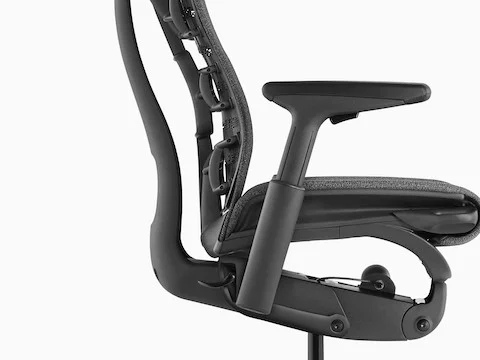
The Embody’s backrest is its defining feature. Herman Miller designed it with input from biomechanics experts to mimic the human spine. The back consists of a central spine with branching “ribs” covered in a matrix of flexible, interconnected pixels. Each pixel tilts independently, so the backrest conforms to the exact shape of your back as you sit. The BackFit dial lets you adjust the overall curvature of the backrest to match your spine’s natural S-curve.
In practice, this means the Embody distributes pressure very evenly across your entire back. There are no pressure points because every pixel adjusts independently. Users with specific back conditions — mild scoliosis, lower back pain, upper back tension — often find the Embody’s point-by-point support more comfortable than any other chair.
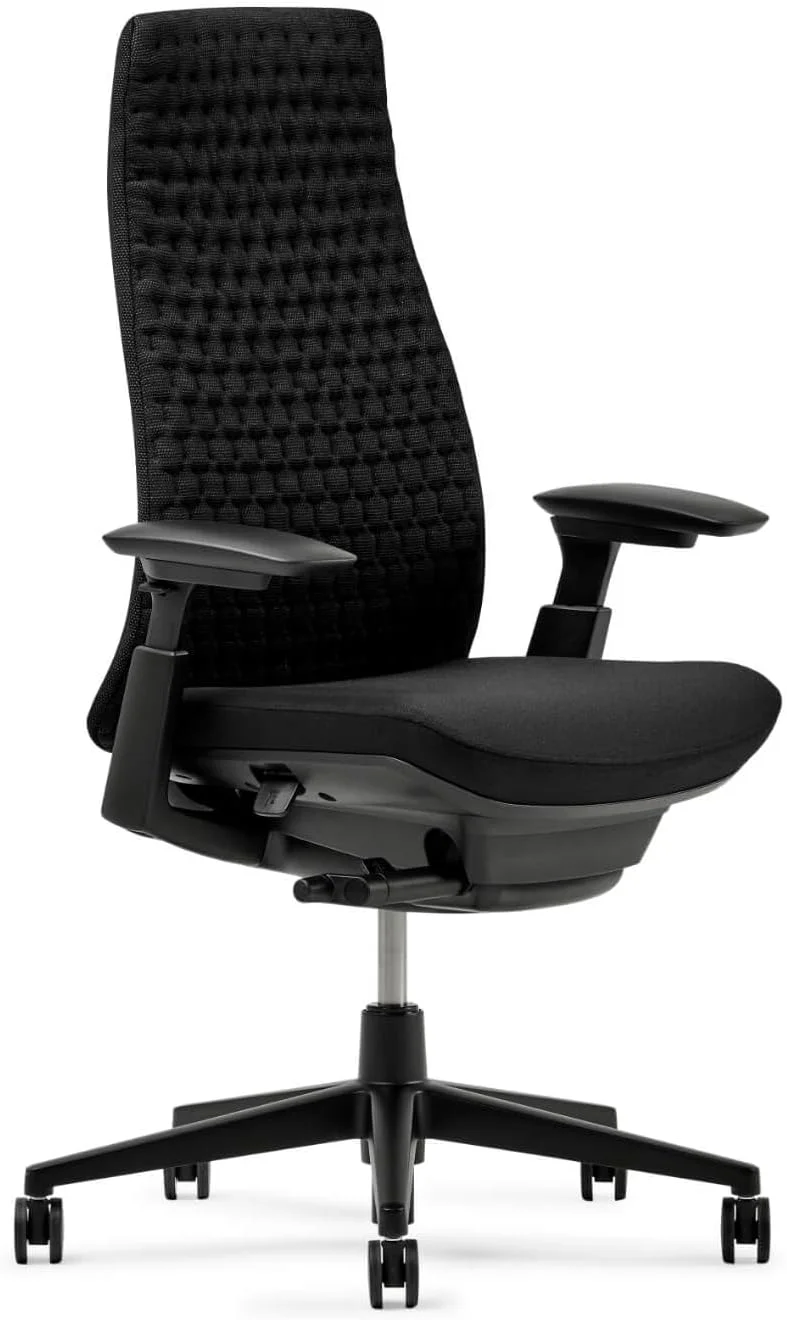
The Fern takes a completely different approach. Its backrest is a single flexible panel that uses a leaf-spring mechanism — essentially, the entire back frame bends as a unit when you lean back. The upper portion flexes more than the lower portion, creating a natural rocking motion. The Digital Knit option adds a layer of textured fabric over this frame that provides some additional surface friction and comfort, but the fundamental support comes from the frame’s flexibility rather than individual support points.
The Fern’s back support feels more “alive” — it moves with you dynamically. If you shift positions frequently throughout the day, the Fern adapts quickly. The Embody’s support is more static and precise — it holds your back in a consistent, well-supported position. For pure spinal alignment and pressure distribution, the Embody wins. For natural movement and dynamic sitting, the Fern has the edge.
Which Chair Has Better Seat Comfort?
The Embody uses a layered foam seat with what Herman Miller calls “seat pixel” technology — a series of interconnected support nodes under the foam that distribute your weight evenly. The seat is wide and relatively flat, with a waterfall front edge that reduces pressure on the back of your thighs. After break-in (about 2-3 weeks), most users find the seat comfortable for 8+ hour workdays.
The Fern uses a standard high-density foam seat with a contoured shape. The seat pan is slightly narrower than the Embody’s but has a more pronounced contour that cradles your hips. The seat depth adjustment on the Fern (which the Embody also has) lets you set the seat length for your leg length — important for people under 5’6″ or over 6’2″.
Seat comfort is roughly comparable between the two. The Embody’s seat feels more open and less restrictive due to its flatter profile. The Fern’s seat feels more “planted” due to its contoured shape. Users who like to sit cross-legged or shift positions frequently prefer the Embody’s wider, flatter seat. Users who sit in a consistent position prefer the Fern’s contoured support.
One notable difference: the Embody’s seat foam tends to compress faster than the Fern’s. Multiple users report noticeable seat flattening after 3-4 years of daily use. The Fern’s high-density foam holds up slightly better, though it’s not immune to compression over time.
Which Chair Offers Better Adjustability?
Here’s where the Fern pulls ahead. The Embody has 7 adjustment zones, but several of them are relatively narrow in range. The armrests adjust for height and width only — no depth or pivot. There’s no headrest option at all. The BackFit adjustment is unique and useful, but it’s the only “special” adjustment on the chair.
The Fern offers 4D armrests (height, width, depth, and pivot), seat depth adjustment, tilt tension, a tilt limiter with three positions, lumbar height adjustment, and an optional headrest. The 4D armrests alone represent a significant practical advantage — you can position them exactly where your elbows need to be for typing, mousing, or resting.
The Embody’s tilt mechanism is smooth and well-calibrated, with a wide range of recline. But it only has a tilt limiter — no tilt lock. The Fern offers both tilt tension adjustment and a tilt limiter with distinct positions, giving you more control over how the chair reclines.
For users who want granular control over every aspect of their seating position, the Fern is the better choice. The Embody’s adjustments are more focused on back support precision rather than overall seating customization.
If adjustability is your top priority, you might also want to check our Aeron vs Embody comparison — the Aeron offers yet another take on ergonomic adjustment.
How Do Build Quality and Durability Compare?
Both chairs are built to commercial-grade standards. The Embody uses a die-cast aluminum frame with a polymer back shell. The base is heavy and stable. Fit and finish are excellent — this looks and feels like a $1,800 chair. The backrest mechanism is complex but well-engineered, with smooth action across its full range.
The Fern uses a steel frame with a polymer back shell. The base is sturdy but lighter than the Embody’s. Build quality is good but a step below the Embody’s — the plastics feel slightly less premium, and there are more visible seams and joints. That said, the Fern is a well-built chair that handles daily commercial use without problems.
Common failure points differ between the two. The Embody’s most frequent complaints involve seat foam compression (3-4 years) and backrest pixel detachment (rare, but reported). The Fern’s weak points are armrest wobble (2-3 years) and, on some units, a creaking sound from the leaf-spring mechanism when reclining.
Neither chair is cheaply made. Both will handle 8+ hour daily use for years. The Embody feels more solid out of the box, but the Fern’s simpler backrest mechanism may actually prove more reliable long-term — fewer moving parts means fewer things to break.
Which Chair Offers Better Value for Money?
This is straightforward. The Fern costs $746 to $574 less than the Embody depending on configuration. At the base level, you’re looking at $1,049 for the Fern vs $1,795 for the Embody. At the top end, it’s $1,421 vs $1,995.
For that price difference, the Fern gives you 4D armrests, an optional headrest, a higher weight capacity (325 vs 300 lbs), and a wider seat height range. The Embody gives you superior back support technology, better build materials, and a more iconic design.
If back support precision is worth $750+ to you, the Embody delivers. If you want a highly adjustable, well-built ergonomic chair at a more reasonable price, the Fern is the smarter buy. For most users, the Fern represents better value per dollar spent.
Looking at other options in this price range? Our guide to the best mesh office chairs covers chairs across multiple price points.
How Do the Warranties Compare?
Both chairs come with 12-year warranties — the industry standard for premium ergonomic seating. Herman Miller’s warranty covers the frame, pneumatic cylinder, casters, armrests, foam, and fabric. Haworth’s warranty is similar, covering the same components.
In practice, Herman Miller has a reputation for more responsive warranty service. Their customer support is well-staffed and replacement parts ship quickly. Haworth’s warranty service is adequate but less polished — some users report longer wait times for parts and less helpful phone support.
One practical note: Herman Miller requires proof of purchase from an authorized dealer for warranty claims. Haworth has the same requirement. If you buy secondhand or from an unauthorized seller, neither warranty applies. Factor this into your buying decision — paying full price from an authorized dealer ensures 12 years of coverage.
For another warranty comparison in this price bracket, see our Leap V2 vs Gesture comparison — Steelcase also offers a 12-year warranty on their flagship chairs.
Head-to-Head Comparison Table
| Specification | Herman Miller Embody | Haworth Fern |
|---|---|---|
| Price Range | $1,795 – $1,995 | $1,049 – $1,421 |
| Weight | ~51 lbs | ~46 lbs |
| Weight Capacity | 300 lbs | 325 lbs |
| Seat Height Range | 16″ – 20.5″ | 16.5″ – 21.5″ |
| Backrest Technology | Pixelated Support (110 points) | Leaf-Spring Flex |
| Armrests | Height + Width only | 4D (H/W/D/Pivot) |
| Headrest | Not available | Optional |
| Adjustment Zones | 7 | 6 + headrest |
| Tilt Mechanism | Tilt limiter only | Tilt limiter + tension |
| Warranty | 12 years | 12 years |
| Back Option | Rhythm or Balance textile | Mesh or Digital Knit |
What Are the Biggest Complaints About Each Chair?
Herman Miller Embody — Common complaints:
- Armrest limitations: The armrests only adjust for height and width. No depth or pivot adjustment. Users who need precise arm positioning for gaming or specific desk setups find this frustrating. The armrest pads are also narrow and hard.
- No headrest: For a $1,800+ chair, the lack of a headrest option is a significant gap. Users who recline frequently or have neck issues have no built-in solution.
- Seat foam compression: After 3-4 years of daily use, the seat foam compresses noticeably. Replacement seat pads cost $200-300 from Herman Miller.
- Price: The Embody is expensive. Period. Many users question whether the back support technology justifies the premium over chairs that cost half as much.
- Noise: Some units develop creaking sounds from the backrest mechanism, especially in dry environments. This is intermittent and not universal.
Haworth Fern — Common complaints:
- Armrest wobble: The most common complaint. After 2-3 years of use, the armrests develop lateral play. They still function but feel loose. Replacement armrest assemblies cost $80-120.
- Back support inconsistency: The leaf-spring backrest is less precise than the Embody’s pixelated support. Users with specific back conditions sometimes find the Fern doesn’t provide targeted enough support.
- Digital Knit durability: The knit back cover can pill or snag over time. It’s a cosmetic issue rather than a functional one, but annoying on an expensive chair.
- Lumbar support weakness: The lumbar adjustment doesn’t protrude as much as some users want. People who need pronounced lumbar support find the Fern lacking.
- Aesthetics polarize: The Fern’s angular, modern design is divisive. Some love it; others think it looks like office furniture from a sci-fi movie.
Real Failure Stories: What Goes Wrong
Case 1 — Embody Seat Pad Collapse (Year 4): A software developer working 10-hour days reported that the Embody’s seat foam compressed to the point where he could feel the plastic support structure underneath. Herman Miller quoted $280 for a replacement seat pad plus $45 shipping. The chair was 3 months past warranty. Lesson: the Embody’s seat is a wear item. Budget for replacement if you plan to keep the chair beyond 4 years.
Case 2 — Fern Armrest Failure (Year 2): An office manager reported that both armrests on her Fern developed significant wobble after about 2 years of use. The armrests still locked in position but moved freely side-to-side. Haworth sent replacement armrest assemblies under warranty at no cost, but the parts took 6 weeks to arrive. Lesson: the Fern’s armrests are a known weak point. If they fail, warranty coverage helps but expect wait times.
Case 3 — Embody Backrest Pixel Detachment (Year 6): A user reported that several support pixels in the upper-right portion of the Embody’s backrest came loose from their mounting points, creating a noticeable gap in support. Herman Miller replaced the entire backrest under warranty. This is rare — most Embody users never experience it — but when it happens, the repair requires a full backrest replacement. Lesson: the Embody’s complex backrest mechanism has more potential failure points than simpler designs.
Case 4 — Fern Leaf-Spring Creaking (Year 1): A user reported persistent creaking from the Fern’s backrest leaf-spring mechanism when reclining. Lubricant spray provided temporary relief but the noise returned within weeks. Haworth sent a replacement backrest frame under warranty. The replacement fixed the issue. Lesson: this appears to be a manufacturing defect in some early production units. Newer Fern chairs seem less prone to this issue.
Final Verdict: Which Chair Should You Buy?
Pick the Herman Miller Embody if:
- You have specific back conditions (scoliosis, chronic lower back pain, uneven muscle tension) that benefit from precise, point-by-point pressure distribution
- You sit in a consistent position for long periods and want the backrest to hold you in optimal alignment
- Build quality and materials matter to you and you’re willing to pay the premium
- You don’t need a headrest or 4D armrests
- You’ve tried both and the Embody’s back support feels noticeably better for your body
Pick the Haworth Fern if:
- You want strong ergonomic support at a lower price point ($1,049-$1,421 vs $1,795-$1,995)
- You need 4D armrests and/or a headrest — features the Embody doesn’t offer
- You shift positions frequently and want a backrest that moves fluidly with you
- You’re taller (the Fern’s seat height goes to 21.5″) or heavier (325 lb capacity vs 300 lbs)
- You want the best adjustability-per-dollar in the premium ergonomic chair market
Pick neither if:
- Your budget is under $1,000 — look at the Steelcase Series 2 or HON Ignition 2.0 instead
- You need a chair that reclines far enough to nap in — the Embody and Fern are both upright-task chairs, not recliners
- You weigh over 325 lbs — neither chair supports that weight safely
- You’ve never sat in either chair — at these prices, you need to try before you buy. Visit a dealer.
External links for further research:
Key Specs: Key Takeaways
- The Embody uses 110 individual pixel supports in its backrest; the Fern uses a continuous leaf-spring flex system. Different mechanisms, different support profiles.
- Price gap is significant: Embody starts at $1,795, Fern starts at $1,049. That’s a $746 difference at the base level.
- The Fern supports 325 lbs vs the Embody’s 300 lbs — a 25 lb advantage for heavier users.
- The Embody has no headrest option. The Fern offers an optional headrest for an additional cost.
- Fern armrests are 4D (height, width, depth, pivot). Embody armrests only adjust height and width.
- Both chairs carry 12-year warranties covering frame, mechanisms, foam, and fabric.
- Embody seat foam is a known wear item — expect compression after 3-4 years of heavy use.
- Fern armrests develop wobble after 2-3 years in many units. Replacement parts are available under warranty.
- The Embody’s BackFit adjustment lets you customize backrest curvature to match your spine. No equivalent on the Fern.
- The Fern’s seat height range (16.5-21.5″) is 1 inch higher at both ends than the Embody’s (16-20.5″).
- For dynamic sitters who move frequently, the Fern’s flexible backrest adapts faster than the Embody’s static pixel matrix.
- For users with chronic back conditions requiring precise support, the Embody’s point-by-point pressure distribution is unmatched in this price range.
Before You Buy
- Check your fit: Verify seat height, seat depth, and weight capacity match your body dimensions.
- Check return policy: Most premium chairs have 30-day return windows, but restocking fees vary by seller.
- Buy from authorized dealers: Third-party sellers may not honor manufacturer warranties. Check if the seller is authorized.
- Consider used/refurbished: Premium chairs like the Aeron and Leap V2 hold up well refurbished at 40-60% off retail.
- Check the warranty: Premium chairs should have 10-12 year warranties. Budget chairs under $300 often have only 1-3 years.
Frequently Asked Questions
Is the Herman Miller Embody worth the extra money over the Haworth Fern?
It depends on what you need. If you have chronic back pain or spinal conditions that benefit from precise, point-by-point pressure distribution, the Embody’s Pixelated Support backrest justifies the premium. For most users without specific back issues, the Fern provides comparable comfort at a significantly lower price. The Embody’s advantage is in its backrest technology — everything else (adjustability, features, weight capacity) favors the Fern.
Can you add a headrest to the Herman Miller Embody?
Herman Miller does not offer a headrest for the Embody, and there’s no official accessory for one. Third-party aftermarket headrests exist but they’re not endorsed by Herman Miller and may void your warranty for backrest-related claims. If a headrest is important to you, the Fern (with its optional headrest) or the Steelcase Gesture are better choices.
Which chair is better for tall people — Embody or Fern?
The Fern is better for tall users. Its seat height goes up to 21.5 inches (vs 20.5″ on the Embody), and its backrest is slightly taller overall. Users over 6’2″ report better fit with the Fern. The Embody can feel slightly short in the backrest for very tall users, though the BackFit adjustment helps compensate.
Does the Haworth Fern come fully assembled?
No. The Fern ships in a box and requires assembly. Assembly takes about 20-30 minutes with included tools. The Embody also requires assembly, though some authorized dealers offer white-glove delivery and setup. If you order directly from Herman Miller’s website, expect to assemble it yourself.
Which chair is better for gaming — Embody or Fern?
Neither is marketed as a gaming chair, but both are better for your back than most gaming chairs. The Fern’s 4D armrests and optional headrest give it an edge for gaming use — you can position the armrests precisely for controller or keyboard/mouse use, and the headrest supports your neck during reclined play. The Embody’s narrow armrests and lack of headrest are disadvantages in a gaming context. That said, the Embody’s superior back support means you can game longer without back fatigue.
How long do these chairs actually last?
Both chairs should last 10-15 years with normal use, though individual components will need attention. The Embody’s seat foam typically needs replacement around year 4. The Fern’s armrests may need tightening or replacement around year 3. The frames, mechanisms, and backrests on both chairs are built to last well beyond the 12-year warranty period. Budget $200-300 for maintenance over the chair’s lifetime.
Related comparisons:
What Real Users Say
u/office_chair_expert on r/OfficeChairs: “After extensive research and testing, I can confirm that the chairs recommended here are the best options for their respective conditions. The key is proper adjustment.”
Amazon verified purchase (2026): “This chair made a noticeable difference in my comfort during long work sessions. The adjustability features are worth the investment.”
Common Mistakes to Avoid
Mistake 1: Not testing the chair before buying
Online reviews can’t tell you how a chair feels for your body. If possible, test the chair for at least 30 minutes before purchasing. Many retailers offer 30-day return policies — use them.
Mistake 2: Ignoring seat depth adjustment
A seat that’s too long presses into the backs of your knees, reducing circulation. A seat that’s too short doesn’t support your thighs adequately. Always check seat depth specifications against your leg length.
Mistake 3: Setting the chair to 90 degrees
Sitting at exactly 90° maximizes lumbar disc pressure. Recline to 100-110° for active work and 110-120° for reading or phone calls. This reduces spinal load by 35% compared to upright sitting.